Secondary tabs
Submission information
Submission Number: 202
Submission ID: 258
Submission UUID: 69fb2632-5840-419c-93fa-56e9fe70763f
Submission URI: /form/submit-contribution
Created: Fri, 27 Feb 2026 - 08:52
Completed: Fri, 27 Feb 2026 - 09:03
Changed: Wed, 13 May 2026 - 08:12
Remote IP address: 81.56.73.67
Submitted by: Anonymous
Language: English
Is draft: No
Current page: webform_confirmation
| Given name | Vittoria |
|---|---|
| Surname | Ecclesia |
| vittoria.ecclesia@bruckneruni.at | |
| I understand that by submitting this form, I consent to the use of my data for the purposes of the 2026 Forum on Artistic Research'. | Yes |
| I agree to the terms of service. | Yes |
| Title | Lingue che Mancano - rediscovering our roots through breath and sound |
| Format | Project presentation |
| Main language | English |
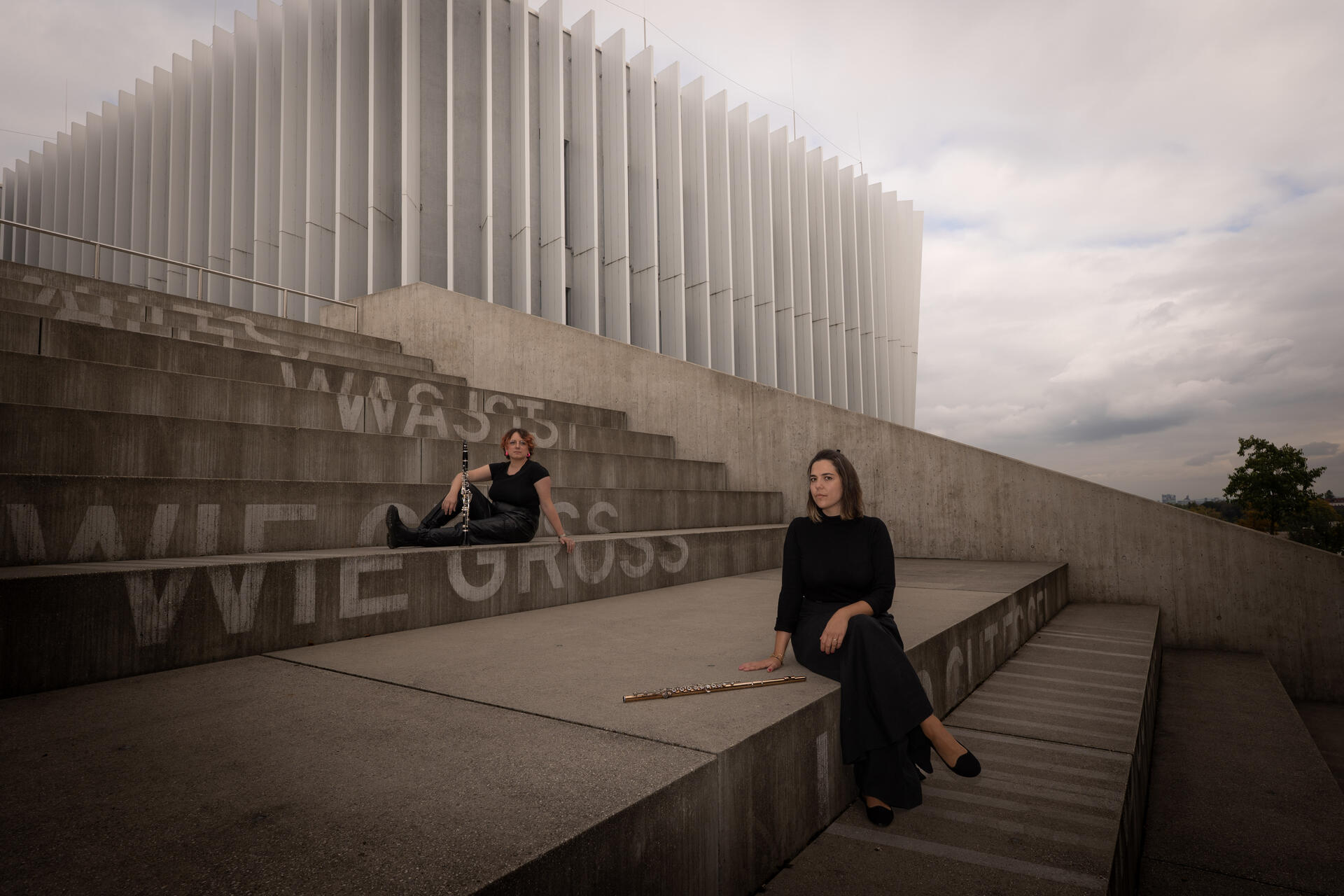
| Abstract | Lingue che Mancano (Missing Languages) is an ongoing artistic research project by the duo 1212, formed by Albane Tamagna (flute) and Vittoria Ecclesia (clarinet). It investigates the intersection of linguistic memory, personal heritage, and contemporary instrumental practice. The project emerges from a shared condition: both artists grew up surrounded by regional languages, Corsican and the Verbano dialect, without acquiring fluency in them. We moved away and became part of the expat communities in different countries, rebuilding and reinventing our identity. Through this project, we want to engage with this common ground of missing languages and spaces, of redefining what “home” means and what “home” sounds like. We ask ourselves: how can musical practice become a site for reactivating through artistic imagination what seems lost? How can the mixture of absence, embodied sonic memory, and lived displacement be translated into a form of knowing and creation? Drawing on autoethnography as a methodological frame, the duo negotiates shared and divergent histories, mediates between contemporary musical languages and regional tradition. Field recordings, folk song archives, oral history interviews with dialect speakers, and the performers’ own memories serve as raw material. From these, hybrid sonic spaces emerge: instrumental timbre fusing with vocal inflections, traditional melodic fragments in dialogue with contemporary techniques, improvisation. The ultimate goal is to create a method of creation rooted in language and memory that can be successfully used by other artists to explore and perform their own roots. Rather than romanticising cultural retrieval, the project proposes music as a generative threshold space: tradition and innovation not opposed but mutually constitutive. The research positions itself within current discourse on practice-based inquiry as a method for addressing questions that exceed conventional academic modes. |
| Link to the Exposition | https://www.researchcatalogue.net/view/4150204/4150205 |
| Image |
|
| Short biographies of the presenter(s) |
|
| Previous presentations or iterations of the research | The project was featured as Performance-presentation at EPARM 2026: https://aec-music.eu/event/european-platform-for-artistic-research-in-music-eparm-2026/programme |
| Additional information | |
| Spatial and technical requirements | Stereo audio playback system and a screen or projector for video. Laptop connection via HDMI. |
| Potential risks or ethical concerns | The project involves interviews with dialect speakers about their memories. Participation is voluntary, fully informed, and individually consented. Audio recordings are used solely as artistic material. The project does not claim ownership or authority over the communities represented, and actively reflects on the ethics of cultural reactivation by outsiders. |
| Create a user account for SAR 2026 | No |