Secondary tabs
Submission information
Submission Number: 204
Submission ID: 260
Submission UUID: f301b6c5-aa08-4d8e-bfed-d2a524370d7a
Submission URI: /form/submit-contribution
Created: Fri, 27 Feb 2026 - 09:16
Completed: Fri, 27 Feb 2026 - 10:04
Changed: Wed, 13 May 2026 - 08:50
Remote IP address: 109.134.158.23
Submitted by: Anonymous
Language: English
Is draft: No
Current page: webform_confirmation
Flagged: Yes
| Given name | Vincent |
|---|---|
| Surname | Thornhill |
| vincent.thornhill@gmail.com | |
| I understand that by submitting this form, I consent to the use of my data for the purposes of the 2026 Forum on Artistic Research'. | Yes |
| I agree to the terms of service. | Yes |
| Title | Land/scraping - Algorithmic Alternatives in Landscape Photography |
| Format | Poster presentation |
| Main language | English |
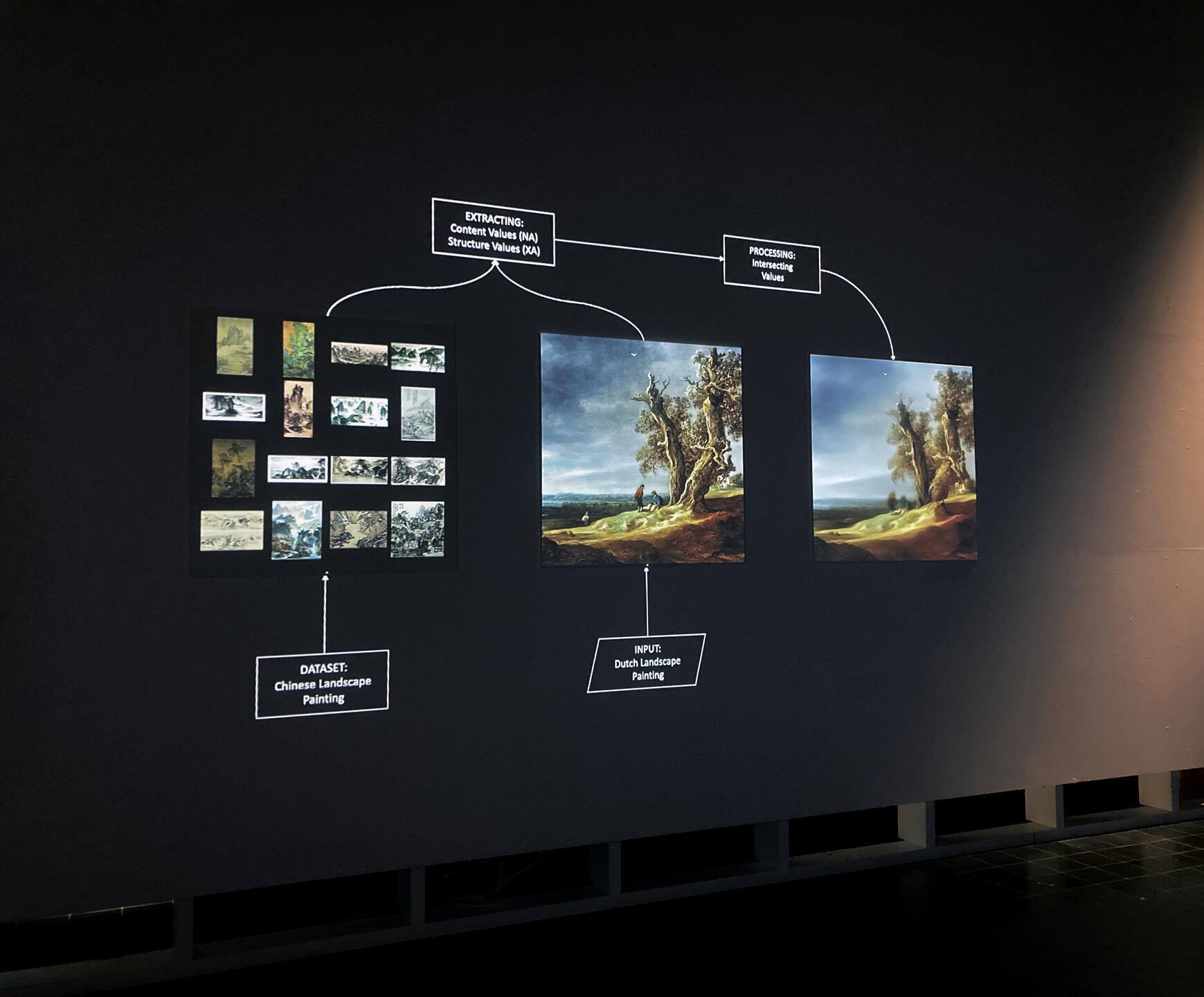
| Abstract | For the 2026 International Forum on Artistic Research, I will present a poster that describes an artistic reinterpration of a machine learning algorithm that engages with cultural and ideological framing of landscape photography in smartphone camera systems. ‘Land/scraping’ is a custom-designed generative image algorithm that explores how the concept of landscape is developed within generative image optimisation processes. In 2021, Google introduced Magic Eraser to its Pixel line of smartphones, enabling users to alter images with machine learning. With generative AI, editing possibilities include swapping clouds for a clear blue sky or a night sky, repositioning objects and people, or removing them altogether. To achieve this, a machine learning model infers what is in an image, what is behind an object when it is removed, or what the user would prefer the image to look like, i.e., a ‘better’ sky or a ‘better’ composition. Land/scraping questions how user experience is mediated, or ‘trained’ through generative image optimisation technology. To experiment with the boundary between algorithmic and cultural training, Land/scraping restages generative AI optimisation tools through training an algorithm to optimise according to contrasting ‘cultural’ understandings of landscapes. By presenting this research as a process diagram, Land/scraping makes visible the influence of ‘cultural atoms’ on conceptions of landscapes and proposes alternative optimisation practices. To achieve this comparison and tension, six ‘alternative image datasets’ of landscapes were created for this art experiment from different cultural, commercial, and time-specific contexts. The diagram provides an overview of how image data was processed in this art experiment, which aims to open up space for speculation on alternative forms of optimisation that can either disrupt dominant conceptions of landscape or reinforce cross-cultural or personal visual experiences through generative AI systems. |
| Image |
|
| Short biographies of the presenter(s) |
|
| Previous presentations or iterations of the research | A video projection of this algorithm was presented at an internal exhibition and seminar at LUCA School of Arts. The poster explanation of the Land/scraping algorithm is made specifically for the 2026 International Forum on Artistic Research. |
| Additional information | Designed as a standard poster presentation |
| Spatial and technical requirements | No special requirements |
| Potential risks or ethical concerns | No ethical concerns |
| Create a user account for SAR 2026 | Yes |
| Create new user | Vincent Thornhill |