Secondary tabs
Submission information
Submission Number: 40
Submission ID: 73
Submission UUID: d0267cce-6bb3-4357-92f7-1006081a65f6
Submission URI: /form/submit-contribution
Created: Mon, 2 Feb 2026 - 08:24
Completed: Mon, 2 Feb 2026 - 09:20
Changed: Wed, 13 May 2026 - 08:54
Remote IP address: 78.63.76.138
Submitted by: Egle Pociuipaite
Language: English
Is draft: No
Current page: webform_confirmation
Flagged: Yes
| Given name | Eglė |
|---|---|
| Surname | Počiuipaitė |
| egle.pociuipaite@gmail.com | |
| I understand that by submitting this form, I consent to the use of my data for the purposes of the 2026 Forum on Artistic Research'. | Yes |
| I agree to the terms of service. | Yes |
| Title | Making the Novelty Myth Sayable: Language, Power, and the Conditions of Design Practice |
| Format | Project presentation |
| Main language | English |
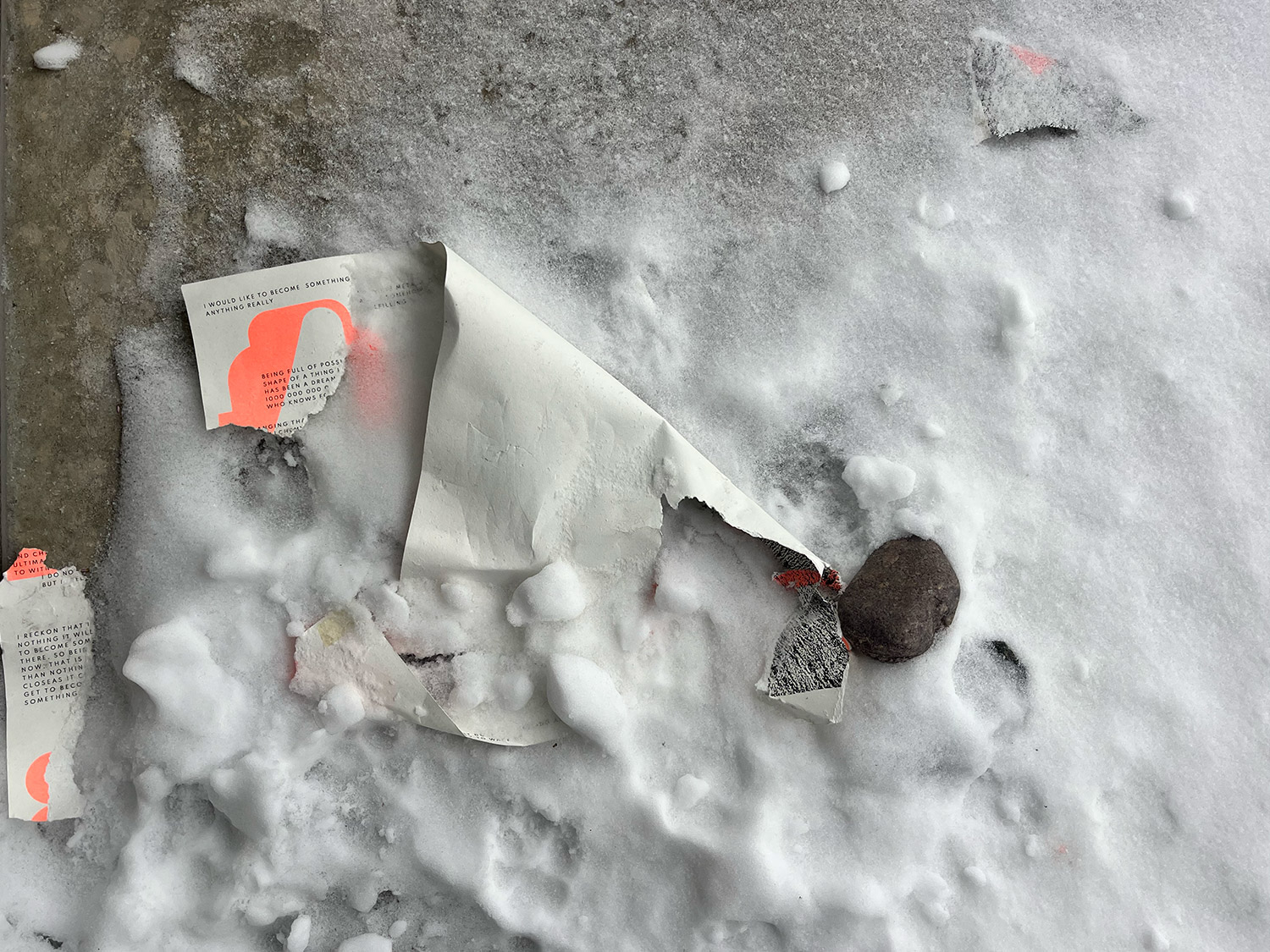
| Abstract | This contribution presents Unagency, a parafictional design agency, created within PhD studies at Vilnius Academy of Arts and used as a practice-based artistic research framework. It investigates the myth of novelty in contemporary graphic design culture. Within commercial design environments, innovation, speed, progress and constant renewal are framed as unquestionable values; whereas doubt, slowness, hesitation, and other less productive states become difficult to articulate from professional discourse, thus remains largely invisible, even to those experiencing it. Unagency operates through a parafictional institutional frame that imitates the language, structures, and procedural formats of commercial design agencies: briefs, deadlines, reports, and productivity rituals, while consciously deforming them. They are transformed to un-brief (assignment without requiring a resolution), un-deliverable (insight without outcome) among the others, for the purpose of un-mything (unravelling of progress and innovation narratives), and function as interventions enabling critical gaze of how novelty imperatives organise everyday design work and produce the belief that novelty equals value, and designers can be agents of change even when structural conditions limit meaningful transformation. Methodologically, the project combines parafictional institutional modelling, hermeneutic-critical design analysis, and reflexive auto-ethnography grounded in long-term professional experience within creative advertising and communication agencies, as well as technology companies. Through different experiments Unagency investigates forms of design experience that have become increasingly unsayable. By attending to doubt, slowness, hesitation, fear of failure, withholding or hoarding of ideas it looks for space for thinking and working modes that resist acceleration, optimisation, and narrative simplification within contemporary creative economies. |
| Link to the Exposition | https://www.researchcatalogue.net/shared/4cb7d9629526f56b8fd5e451d5ba8270 |
| Image |
|
| Short biographies of the presenter(s) |
|
| Previous presentations or iterations of the research | Elements of this research have been developed through doctoral work at the Vilnius Academy of Arts and through internal academic presentations within the PhD programme. Individual experiments have been exhibited in group exhibitions and workshops in Lithuania (2022–2024), but the proposed contribution has not previously been presented in its current form. |
| Additional information | The contribution is presented as an artistic research project combining parafictional structures, written protocols, visual documentation, and practice-based experiments. The presentation focuses on how design myths operate rather than on showcasing finished artifacts. The format is adaptable to both presentation and discussion-based contexts. |
| Spatial and technical requirements | The contribution can be presented using a standard conference setup. Requirements include a projector or screen for images and text. The work can also be presented entirely digitally if needed. |
| Potential risks or ethical concerns | The research does not involve human subjects, sensitive data, or vulnerable populations. It draws on auto-reflexive professional experience and publicly presentable design materials. Any personal reflection is limited to the researcher’s own experience and does not disclose confidential or identifiable information. |
| Create a user account for SAR 2026 | Yes |
| Create new user |