Secondary tabs
Submission information
Submission Number: 210
Submission ID: 268
Submission UUID: a6053f83-9c5f-4d36-b760-1e5866332d4d
Submission URI: /form/submit-contribution
Created: Fri, 27 Feb 2026 - 11:29
Completed: Sat, 28 Feb 2026 - 16:21
Changed: Wed, 13 May 2026 - 08:12
Remote IP address: 194.81.31.10
Submitted by: Anonymous
Language: English
Is draft: No
Current page: webform_confirmation
Personal Information
Your contribution
Threads of Accusation: Artistic Research and the Afterlives of Witch Persecution
English
This presentation examines how interactive immersive installation can make endangered conceptual worlds seeable and sayable. Conducted during a 2026 Fulbright Fellowship at Glasgow School of Art, the project engages histories of witch persecution in Scotland, focusing on the 1697 Renfrewshire trials and the figure of Christian Shaw. Rather than treating witch persecution as superstition superseded by rationality, the research approaches it as a conceptual world structured by belief, rumor, testimony, and embodied knowledge. These epistemic formations, rooted in a specific historical context yet echoed in contemporary systems of power, reveal how language, accusation, and institutional authority co-produce reality.
Through experimental installation and interactive prototypes, the project explores the interplay between power and speech, examining how suspicion circulates, how touch becomes evidence, and how speech and action become punishable. The work extends earlier projects including Witch Pricker (2013) and Blue Boar VR (2019), situating them within a focused investigation of systems of accusation that occurred in Scotland.
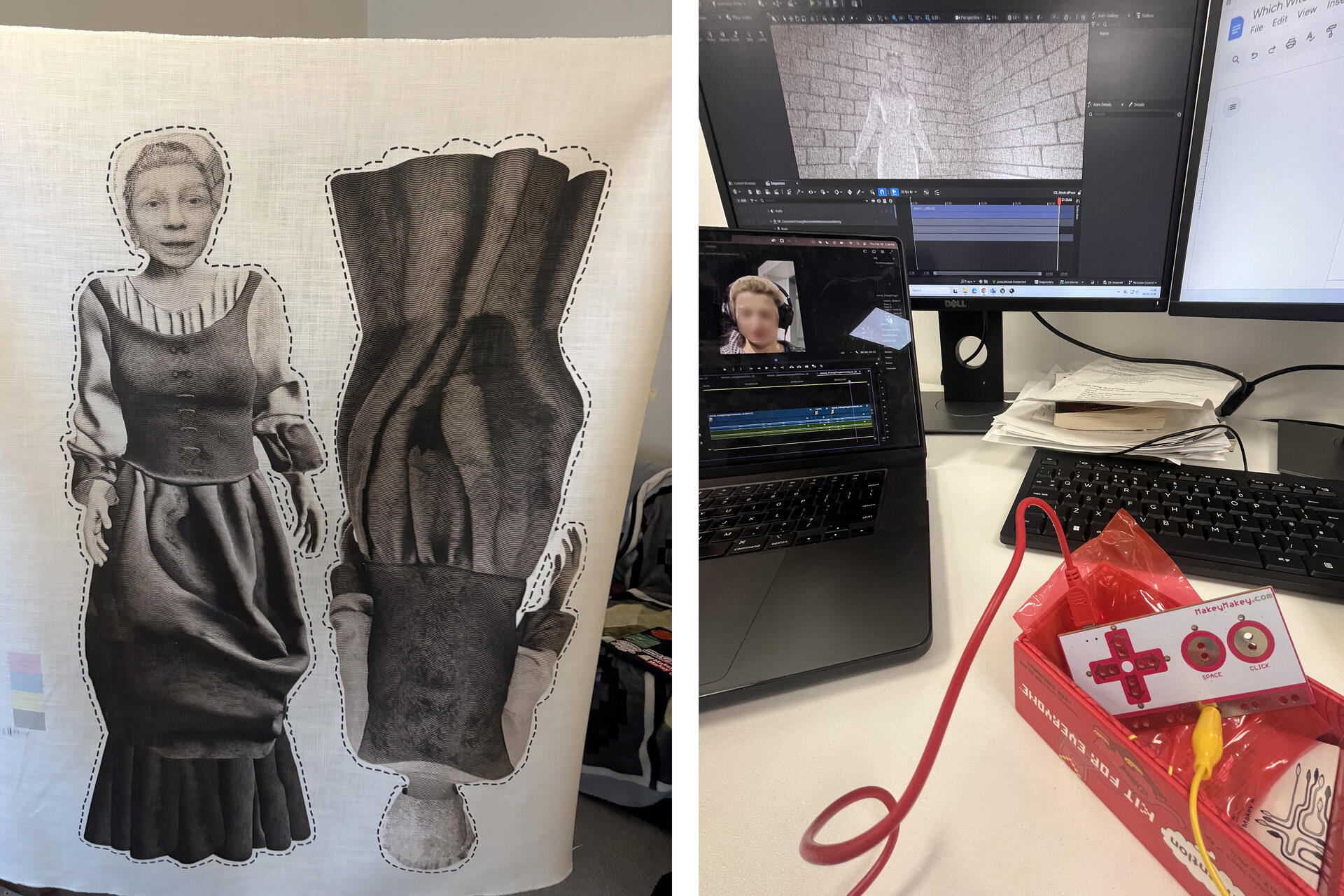
Methodologically, the project combines historical research with prototyping in Unreal Engine and installation development. It embraces uncertainty as a research condition, using technical and material interaction to examine how belief systems operate socially and internally. The research asks viewers to re-experience histories of accusation as systems rather than isolated events. It asks what becomes visible when belief, language, and economic structures are treated as lived conditions, and how artistic research can create space to encounter these conditions differently. Using a game engine, AI, code, and textiles as artistic materials, the project explores how accusation operates as language, atmosphere, and system. It holds these fragile conceptual worlds open long enough for their internal logics and consequences to become perceptible.
Through experimental installation and interactive prototypes, the project explores the interplay between power and speech, examining how suspicion circulates, how touch becomes evidence, and how speech and action become punishable. The work extends earlier projects including Witch Pricker (2013) and Blue Boar VR (2019), situating them within a focused investigation of systems of accusation that occurred in Scotland.
Methodologically, the project combines historical research with prototyping in Unreal Engine and installation development. It embraces uncertainty as a research condition, using technical and material interaction to examine how belief systems operate socially and internally. The research asks viewers to re-experience histories of accusation as systems rather than isolated events. It asks what becomes visible when belief, language, and economic structures are treated as lived conditions, and how artistic research can create space to encounter these conditions differently. Using a game engine, AI, code, and textiles as artistic materials, the project explores how accusation operates as language, atmosphere, and system. It holds these fragile conceptual worlds open long enough for their internal logics and consequences to become perceptible.
- Dr. Victoria Bradbury is an Associate Professor and Chair of New Media at UNC Asheville and the 2026 US–UK Fulbright Distinguished Scholar at Glasgow School of Art. She specializes in interactive and immersive media storytelling. She received an Epic MegaGrant in 2020 to combine Unreal Engine with VR and physical computing and an NEH Connections grant in 2022. She co-edited Art Hack Practice: Critical Intersections of Art, Innovation and the Maker Movement and her work has been exhibited worldwide, including at IEEE-GEM, xCoAx, the {Re}Happening, Harvestworks, The Albright Knox, and The New Britain Museum of American Art. She holds a PhD from the University of Sunderland and an MFA from Alfred University.
This research has not been presented previously.
Requirements
This work is in-progress in Spring 2026 in Glagow. It is developing through an iterative process of researching, recording and motion capture sessions, Unreal Engine development, Photoshop compiliations, work in the weaving studio, printing at Centre for Adanced Textiles, and testing of technological interactive modalities. The project will be further iterated and documented in interactive installation format before the SAR conference.
If a presentation, simply a slide presentation with audio.
If the project could be fully installed, it would require a PC computer and projector and approx 8' x 8' x 8' space (installation size is variable). One or more weavings would need to be hung on a wall.
If the project could be fully installed, it would require a PC computer and projector and approx 8' x 8' x 8' space (installation size is variable). One or more weavings would need to be hung on a wall.
N/A
Yes
Victoria Bradbury