Secondary tabs
Submission information
Submission Number: 207
Submission ID: 265
Submission UUID: 5dce9d1f-07a9-4243-a044-5ef22441b147
Submission URI: /form/submit-contribution
Created: Fri, 27 Feb 2026 - 10:16
Completed: Fri, 27 Feb 2026 - 12:29
Changed: Wed, 13 May 2026 - 08:13
Remote IP address: 80.233.58.169
Submitted by: Anonymous
Language: English
Is draft: No
Current page: webform_confirmation
Flagged: Yes
Personal Information
Your contribution
Who Gets to Speak about Climate Risk & Resilience?: Artistic Practice as Epistemic Intervention
English
The climate crisis necessitates engagement across diverse backgrounds, cultures, and disciplines, each shaped by distinct linguistic and experiential contexts. However, language is frequently homogenised in pursuit of improved collaboration, marginalising lived experience and cultural nuance, and reinforcing power structures. This workshop draws on interdisciplinary projects (BluePrint and DIRECTED), reflecting on challenges in climate risk communication to surface, recognise and integrate diverse knowledge across policy, science and communities. Jointly led by a climate adaptation scientist, design researcher and a facilitator with a background in anthropology and artistic practice, the workshop foregrounds different situated perspectives, revealing how knowledge is created, interpreted, and experienced. Artistic practice is treated as a diagnostic method rather than a tool for engagement or delivery. Ethnographic and arts-based approaches produce and hold situated, embodied knowledge and reveal why unstructured dialogue often fails in complex governance settings.
The workshop invites participants to engage with the challenges of socially engaged art–science collaboration through creative and playful exercises using case studies from shared practice, a performance poetry process and facilitated reflection. This co-production process makes conceptual framing of responsibility, uncertainty and possibility less abstract and reveals the disconnect between technical language and lived experience. Facilitated reflection considers how certain forms of knowledge gain recognition, shaping interpretations and responses. The workshop becomes a shared inquiry into how climate risk and resilience is understood and how alternative ways of knowing can reconfigure dialogue and emerging solutions. Impact is epistemic: it makes power in language visible and sayable, while recognising marginalised knowledge as legitimate in climate risk governance.
The workshop invites participants to engage with the challenges of socially engaged art–science collaboration through creative and playful exercises using case studies from shared practice, a performance poetry process and facilitated reflection. This co-production process makes conceptual framing of responsibility, uncertainty and possibility less abstract and reveals the disconnect between technical language and lived experience. Facilitated reflection considers how certain forms of knowledge gain recognition, shaping interpretations and responses. The workshop becomes a shared inquiry into how climate risk and resilience is understood and how alternative ways of knowing can reconfigure dialogue and emerging solutions. Impact is epistemic: it makes power in language visible and sayable, while recognising marginalised knowledge as legitimate in climate risk governance.
- Dr Lydia Cumiskey is a senior postdoctoral researcher at the MaREI Centre, University College Cork working on enhancing disaster resilience in the EU Horizon funded DIRECTED project. Over the past 10 years Lydia has worked in research and consultancy projects in the areas of flood risk governance, risk communication and climate adaptation. Her recent work in the EU Horizon funded DIRECTED project focuses on capacity building for knowledge co-production in Real World Labs and embracing creativity for collaboration. She led the Creative Ireland funded project BluePrint which co-created artistic risk communication outputs supporting communities and policymakers together with artist Sara Walmsley.
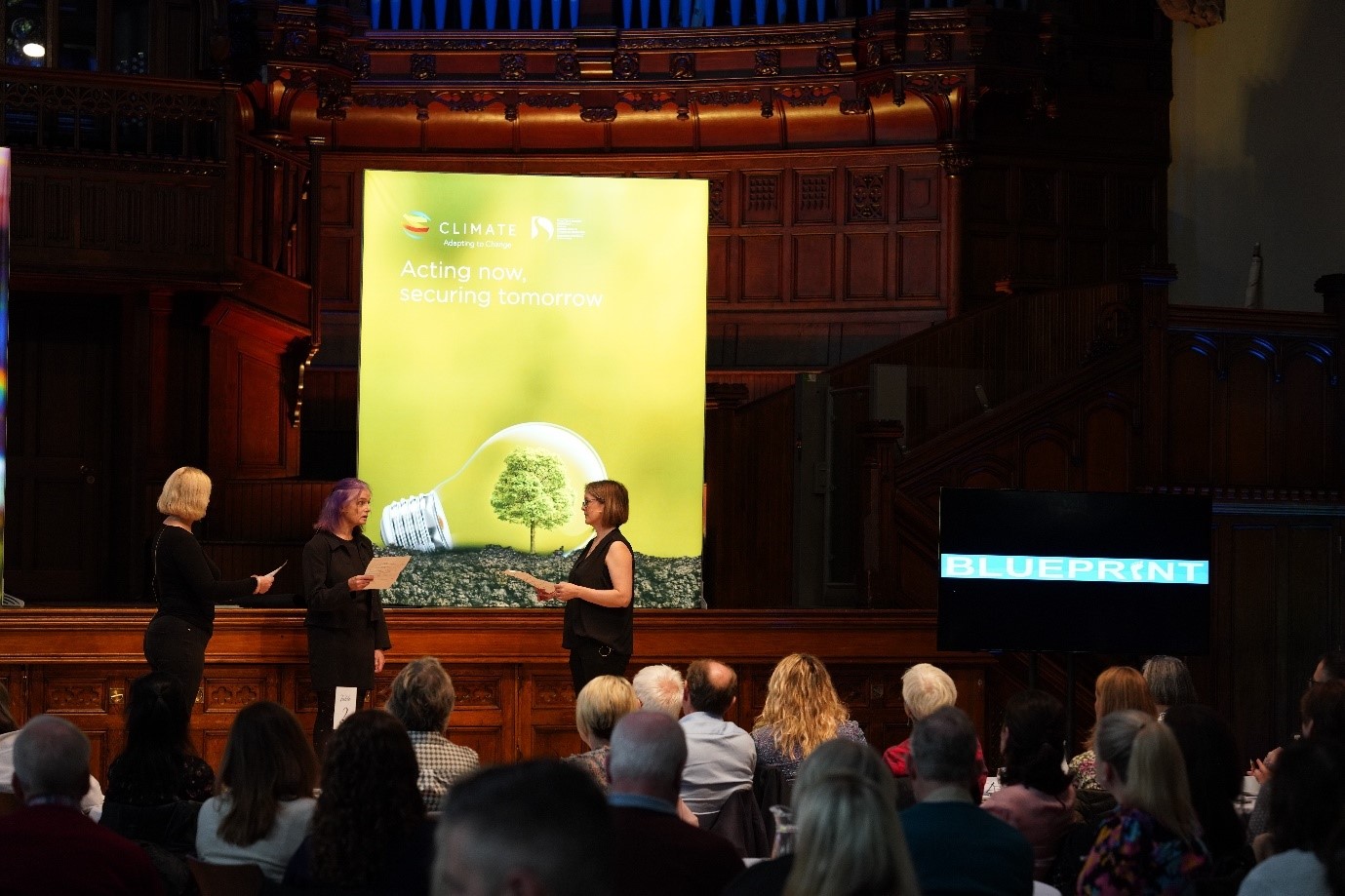
- Dr Sara Walmsley blends anthropological research, creative engagement and artistic practice to amplify the lived experience of communities facing climate change. Recent collaboration with climate adaptation scientists on flooding (BluePrint 2024) demonstrated that co-creative spaces generating dialogue can inspire new responses to climate risk by building agency and resilience.
Her current work investigates the potential for data sonification to trigger new perspectives in multi-stakeholder team exchanges around climate disaster risk management (EU DIRECTED) and promote deliberative governance. - Natascha Ng is a design researcher working on co-production and capacity development in the DIRECTED project at the Stockholm Environment Institute, Oxford, UK. Natascha employs systems thinking, design mapping, and creative methods – along with community-organizing methodologies – to facilitate co-design for transitions. Prior to joining SEI, Natascha worked as a Researcher at UAL, where she applied Design for Transitions thinking, to co-define problems and co-create pathways, for socially just and ecologically sustainable transitions. Within DIRECTED, she supported SEI to host two student Designers-in-Residence, Dipper Hong and Gigi Wang, who co-designed an exercise using visual metaphors to explore, understand, and discuss language.
Walmsley, S., Cumiskey, L., et al. (2024). Extract from BluePrint sound installation "In at Midnight and Away by Morning: The Uninvited Guest". Zenodo. https://doi.org/10.5281/zenodo.14036832
Walmsley. S., Cumiskey. L., et al (forthcoming). Strengthening Active Citizenship for Climate Resilience through Artistic Co-Creation. In S.Flood et al (Eds), Community Climate Justice: Building on equitable adaptation practices and the implications for policy, science and leadership. Palgrave Macmillan.
Walmsley. S., Cumiskey. L., et al (forthcoming). Strengthening Active Citizenship for Climate Resilience through Artistic Co-Creation. In S.Flood et al (Eds), Community Climate Justice: Building on equitable adaptation practices and the implications for policy, science and leadership. Palgrave Macmillan.
Requirements
This 180-minute participatory art–science workshop combines short case studies, creative exercises and structured reflection. After a brief introduction and warm-up, participants work through themed activities using images, voice, tableau and movement. A guided performance poetry process moves from individual writing to group composition and sharing. The session concludes with facilitated plenary discussion linking insights to climate risk and resilience practice.
• max 20 participants
• room for movement and group work
• tables and chairs for group
• workshop to be in non-public area with suitable acoustics for group work
• Audio/Visual for sharing short extracts
• room for movement and group work
• tables and chairs for group
• workshop to be in non-public area with suitable acoustics for group work
• Audio/Visual for sharing short extracts
n/a
Yes
{Empty}