Secondary tabs
Submission information
Submission Number: 371
Submission ID: 440
Submission UUID: 20618aa3-8541-4d92-b6bd-9d5cb636f63b
Submission URI: /form/submit-contribution
Created: Mon, 2 Mar 2026 - 12:53
Completed: Mon, 2 Mar 2026 - 20:44
Changed: Fri, 5 Jun 2026 - 07:32
Remote IP address: 83.135.15.149
Submitted by: Karoline Schneider / Krawc
Language: English
Is draft: No
Current page: webform_confirmation
Flagged: Yes
| Given name | Karoline |
|---|---|
| Surname | Schneider / Krawc |
| kaschneider@posteo.de | |
| I understand that by submitting this form, I consent to the use of my data for the purposes of the 2026 Forum on Artistic Research'. | Yes |
| I agree to the terms of service. | Yes |
| Title | ryć/rěč |
| Format | Project presentation |
| Main language | English |
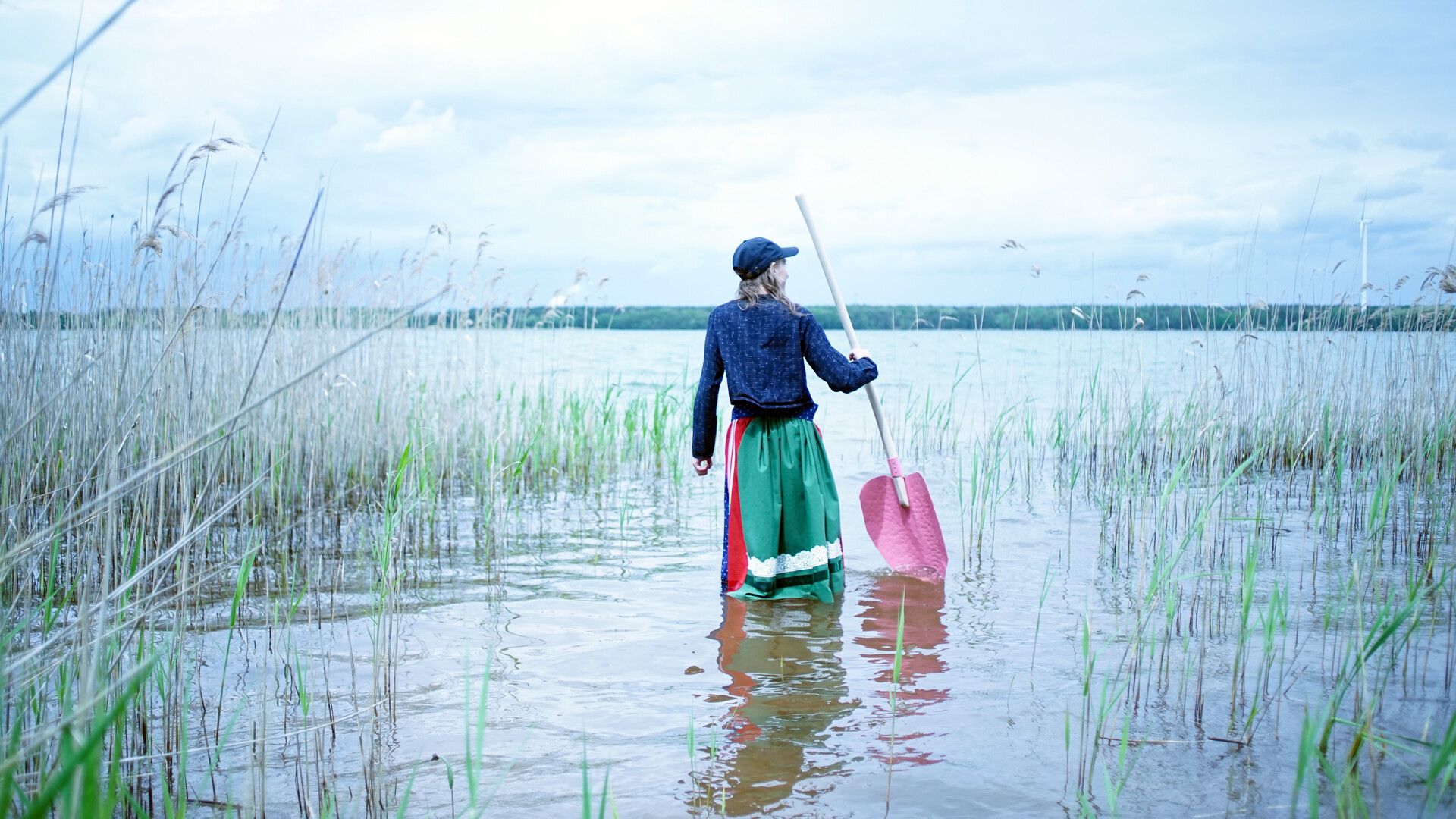
| Abstract | languages: Upper Sorbian, English and German In my autoethnographic project ryć / rěč (2025), I draw on the phonetic proximity of the Upper Sorbian words ryć (dig!) and rěč (speak!) to describe the embodied process of relearning Upper Sorbian (serbski jazyk). Digging and speaking become one gesture: I imagine my tongue as a spade cutting through sedimented histories of silence, shame, and loss. In my family, Sorbian was actively unlearned by my grandmother—yet her decision must be understood within a broader history of repression and devaluation in the German majority context. Nineteenth-century accounts document how for example teachers “waged war” on Sorbian language and dress, forcibly removing girls’ traditional bonnets in schools, producing ruptures that extended across generations. My family history is further marked by extraction. The village of Šiboj, birthplace of my great-grandmother, was destroyed by coal mining; today Lake Šiboj covers its remains. I was born in the year the site was excavated. Building a paddle shaped like a tongue, I move across the lake as a performative act of return, asking what can be recovered from submerged ground. Linguistic and geographic migrations—between Upper and Lower Lusatia and Dresden—produced hybrid forms of speech in my family. Becoming Sorbian again thus appears not as a return to an origin, but as a negotiation of layered identities. Within a sorbian/wendish queer feminist collective, I understand this process as a queering of belonging: creating space to question patriarchal traditions, to name gaps, and to embrace the Sorbian/Wendish minority as a plurality within itself. |
| Link to the Exposition | https://www.researchcatalogue.net/shared/511c65ab93eaf9b8a3e5a37b7c8ad084 |
| Image |
|
| Short biographies of the presenter(s) |
|
| Previous presentations or iterations of the research | The Installation ryć/rěč was part of the international Group exhibition "family matters" at Museum of Fine Arts Leipzig: https://mdbk.de/ausstellungen/family-matters/ https://www.karolineschneider.me/works-tworby#/rycrec/ |
| Additional information | I don't have any additional information at the moment. I use Upper Sorbian and Lower Sorbian languages. I prepare subtitles for this purpose. Experimental elements can be implemented in a conventional presentation setting. |
| Spatial and technical requirements | I will only need a projector and some space. |
| Potential risks or ethical concerns | There are no specific risks or ethical concerns. |
| Create a user account for SAR 2026 | Yes |
| Create new user | Karoline Schneider / Krawc |