Secondary tabs
Submission information
Submission Number: 361
Submission ID: 428
Submission UUID: 93cd2606-a042-4e95-82b9-5216c8665725
Submission URI: /form/submit-contribution
Created: Mon, 2 Mar 2026 - 03:26
Completed: Mon, 2 Mar 2026 - 04:39
Changed: Wed, 13 May 2026 - 08:24
Remote IP address: 159.112.231.163
Submitted by: Anonymous
Language: English
Is draft: No
Current page: webform_confirmation
Flagged: Yes
Personal Information
Your contribution
Time Travel: Embodied Artistic Research as Tactile Archive, Ancestral Memory, and Pedagogies of Slowness
English
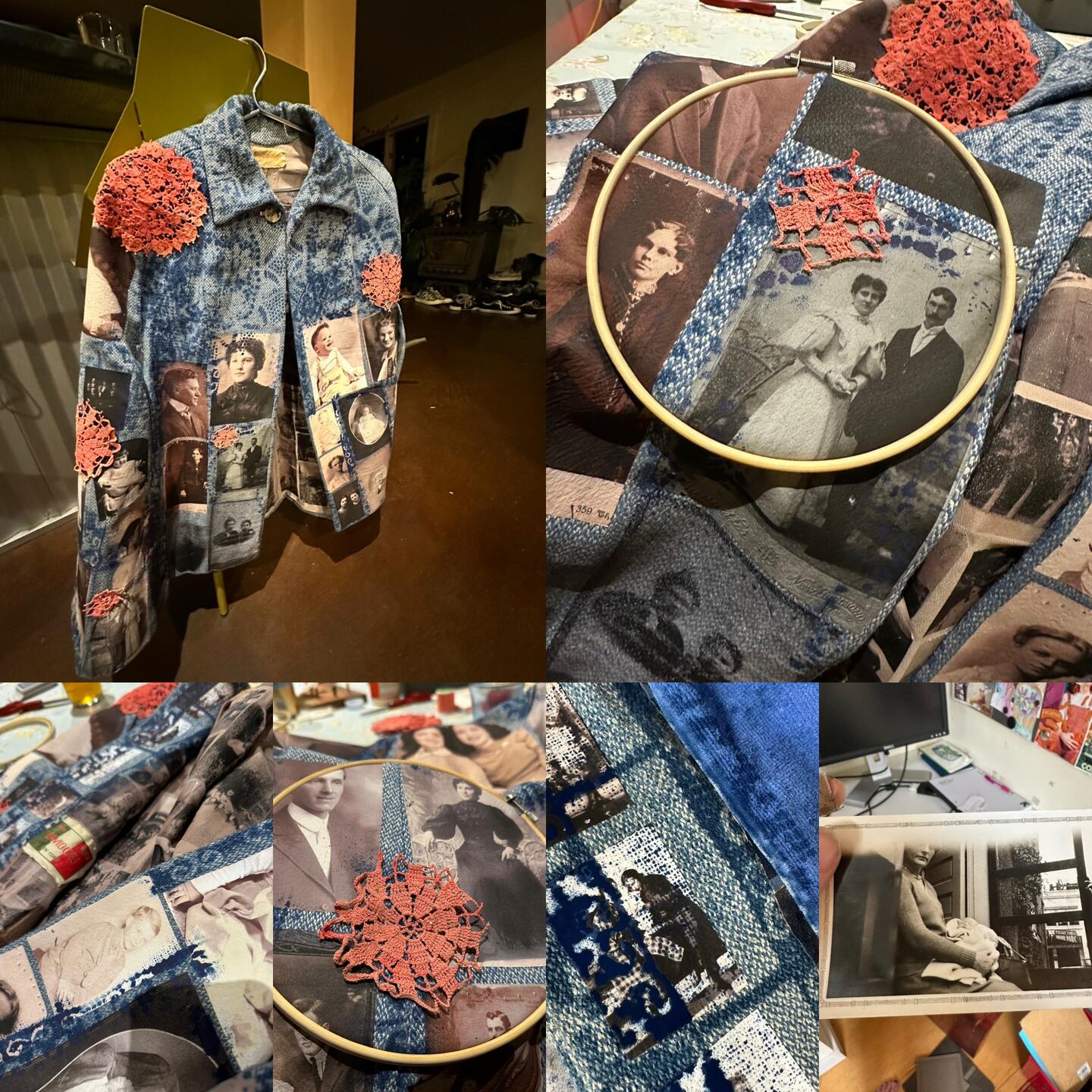
This laboratory invites participants into a live, tactile encounter with a reconstructed 1950s wool cloak transformed through arts-based educational research. The garment; altered with archival photographs, Irish lace, spray stencils, and layered stitching; functions as both artifact and method. It holds a lineage: Irish ancestors displaced by famine in the late 1800s, settling in Wisconsin on already-colonized land; a great-grandmother married at sixteen after losing her first baby; a grandmother sent away in 1952 as an unmarried mother. Their silence and hardness, once read as cruelty, begin to surface as sedimented grief shaped by migration, assimilation into whiteness, and the moral scripts of respectability.
Rather than presenting findings, this laboratory stages artistic research as process. Participants are invited to move around the cloak, examine interior and exterior layers, listen to short audio excerpts, and engage in guided material reflection. The inquiry centers how conceptual worlds are stitched into garments, rituals, and bodies, and how colonial extraction relocates itself across generations, from land to family to marrow.
A companion video and paper, Good White Women extends this research through performative layering and feminist self-critique; however, the cloak remains the primary research site: a living archive that resists efficiency and self-branding through slowness, tactility, and embodied attention.
This experimental format responds to the Forum’s call by foregrounding endangered embodied and domestic knowledges, those often dismissed as private or apolitical, and by positioning artistic research as a space where inherited goodness can be examined, unsettled, and turned inside out.
Rather than presenting findings, this laboratory stages artistic research as process. Participants are invited to move around the cloak, examine interior and exterior layers, listen to short audio excerpts, and engage in guided material reflection. The inquiry centers how conceptual worlds are stitched into garments, rituals, and bodies, and how colonial extraction relocates itself across generations, from land to family to marrow.
A companion video and paper, Good White Women extends this research through performative layering and feminist self-critique; however, the cloak remains the primary research site: a living archive that resists efficiency and self-branding through slowness, tactility, and embodied attention.
This experimental format responds to the Forum’s call by foregrounding endangered embodied and domestic knowledges, those often dismissed as private or apolitical, and by positioning artistic research as a space where inherited goodness can be examined, unsettled, and turned inside out.
- Amy Sparks is an educational researcher and arts-based practitioner exploring critical whiteness, embodiment, ancestral memory, and liberatory pedagogy. Her work integrates arts-based educational research, performance, and material inquiry to examine how colonial inheritances shape teaching and learning. She centers slowness, relationality, and anti-hegemonic methodologies in both scholarship and practice.
{Empty}
Requirements
The laboratory will function as an open, durational space rather than a fixed presentation. The cloak will be displayed (worn or on a dress form), with documentation images and QR access to process video. Participants may enter and exit during the session.
Short facilitated prompts will occur intermittently, inviting tactile reflection using simple materials (fabric scraps, tracing paper, thread). The format emphasizes slow looking, quiet dialogue, and relational inquiry rather than lecture. The space operates as an unfolding research site where participants collectively examine how inherited conceptual worlds are materially constructed.
Short facilitated prompts will occur intermittently, inviting tactile reflection using simple materials (fabric scraps, tracing paper, thread). The format emphasizes slow looking, quiet dialogue, and relational inquiry rather than lecture. The space operates as an unfolding research site where participants collectively examine how inherited conceptual worlds are materially constructed.
Open room or flexible studio space with tables arranged to allow participants to gather and work collectively. Seating for small-group conversation and shared making. Materials table for fabric, paper, thread, and writing tools.
Dress form or hanger for cloak display.
Video monitor or projector with sound to loop the cloak-making process video.
Soft lighting preferred for textile visibility.
Dress form or hanger for cloak display.
Video monitor or projector with sound to loop the cloak-making process video.
Soft lighting preferred for textile visibility.
The work engages ancestral histories and colonial inheritance. Pseudonyms are used for living relatives. Participants will not be required to disclose personal histories; reflective prompts remain invitational. The inquiry may surface discomfort regarding whiteness, assimilation, and complicity; this is framed as generative rather than confrontational.
No