Secondary tabs
Submission information
Submission Number: 329
Submission ID: 395
Submission UUID: ac6dba9d-24ee-40d5-9671-a89679b4467a
Submission URI: /form/submit-contribution
Created: Sun, 1 Mar 2026 - 17:56
Completed: Sun, 1 Mar 2026 - 18:00
Changed: Wed, 13 May 2026 - 08:14
Remote IP address: 145.79.198.102
Submitted by: Noah Rose
Language: English
Is draft: No
Current page: webform_confirmation
| Given name | Noah |
|---|---|
| Surname | Rose |
| noah@noahrose.net | |
| I understand that by submitting this form, I consent to the use of my data for the purposes of the 2026 Forum on Artistic Research'. | Yes |
| I agree to the terms of service. | Yes |
| Title | Sa teanga Ghaedhilge bhlasda bhinn: Sculpting the linguascape ‘in the tasty, sweet Irish language’ |
| Format | Project presentation |
| Main language | English |
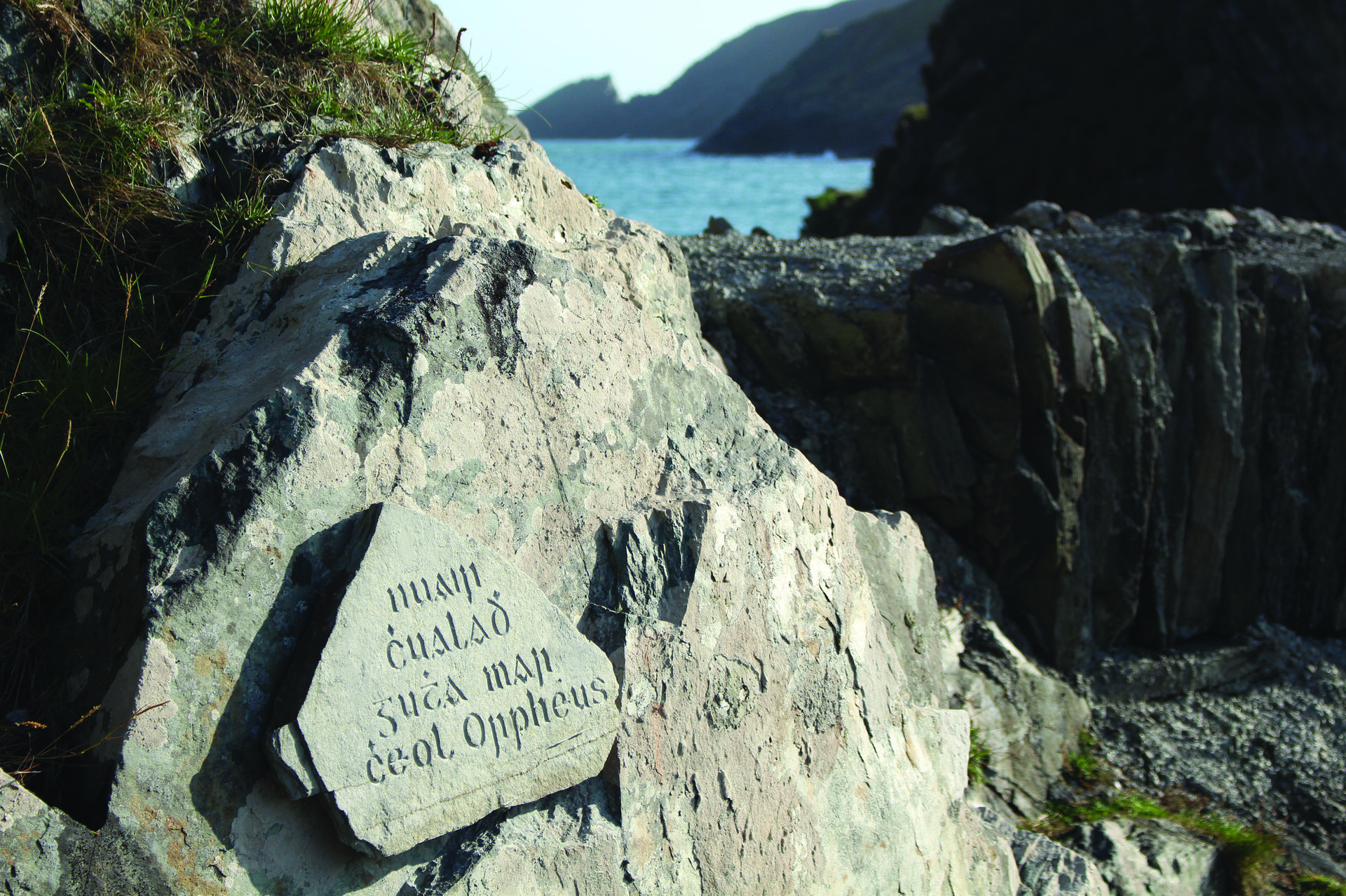
| Abstract | How can expanded sculptural practice and the Irish language augment one another to transmit ephemeral cultural-linguistic knowledge through direct engagement with place? In 2020, I was an artist in residence on the gaeltacht (officially-designated Irish-speaking) island of Oileán Chléire/ Cape Clear, Co. Cork Situated knowledge acquired during a 2-month residency at a time of Covid-19 restrictions, led to a novel, practice-led methodology - a fluid combining of creative methods such as field exploration, drawing, photography, archival research, historical typographical design, hand letter-cutting and contemporary archaeological practices. My methodology incorporated language-learning in Irish, to examine challenges around communicating ephemeral cultural-linguistic knowledge between native, new and non-speakers on a small gaeltacht island (permanent population 130) where linguacultural tourism is an essential part of the ecosystem. Following Tim Ingold’s ‘Taskscape’ (Ingold, 1993) through which landscape can be perceived through the accretions of human activity over time, I use a new term to define how landscape might be perceived through a linguistic lens: the ‘Linguascape/ Teangadhreach’. Diverse creative practices were combined to materialise text from a 200 year old poem (author unknown) sourced from the Dúchas digital repository of the National Folklore Archive - to create a sculptural text-based installation, ‘Leabharlann na gClocha ceilte/ The Hidden Stone Library’, now permanently installed around the island in 8 locations, connected by walking trail. In this presentation I unpack some of the complexities of understanding cultural-linguistic landscapes through sculptural materialisation of ephemeral source texts in minoritised language settings. I expand on how the novel concept of ‘linguascape/ teangadhreach’ can enhance understanding of hyper-local knowledge and the contribution the made word can make to understanding the world. |
| Link to the Exposition | https://www.researchcatalogue.net/shared/c9007fd7813a27bf0880b79754f22471 |
| Image |
|
| Short biographies of the presenter(s) |
|
| Previous presentations or iterations of the research | This research informed a case study as part of my PhD: ‘Sculpting the Linguascape/ Ag dealbhú an Teangadhreach: unearthing place-based knowledge in the Irish language through expanded sculptural practice’ awarded by Glasgow School of Art, December 2025 (thesis unpublished). An earlier iteration was presented with a different research focus at the conference ‘Linguacultural Spaces: Inclusion, Extension and Identification in Discourse and Society (2021), Universities of Bologna, Glasgow & Tilburg |
| Additional information | My presentation will be richly visual, with photographs, video, drawings - and potentially sculpture - demonstrating work created during my 2020 residency on the Gaeltacht island of Oileán Chléire/ Cape Clear, Co. Cork - during a time of Level 5 Covid-19 lockdown restrictions. I unpack the processes of contextual, archival and artistic research, including contemporary archaeological practices to permanently install work within the island’s fragile ecology through respectful engagement with the island community. I examine ethical considerations regarding community engagement, Covid-19 adaptations, archival, translation and typographical design issues. The main language of the presentation will be English but with essential phrases in Irish. As an active learner of Irish, resident in Ireland but with no familial connection to Irish, I will examine some of the challenges around communicating cultural-linguistic knowledge between native, new and non-speakers of minoritised languages. |
| Spatial and technical requirements | The presentation will be made using Keynote on my own computer (MacBook Pro, 2021 M1 Pro with HDMI port). The presentation relates to work which is installed in-situ on a remote island, but there is also an option to physically display a sculpture that forms a companion piece to the installed work. This sculpture is approx 60x60x150cm and can be moved by one person. It can be shown during the presentation and installed anywhere in the venue for the duration of the conference. |
| Potential risks or ethical concerns | All research was conducted in accordance with Glasgow School of Art’s Research Ethics Policy and approved by GSA Research department - no additional ethical issues are envisaged. If the option to display the sculpture is chosen, this has already been displayed within 2 gallery spaces in Glasgow School of Art and has been approved by 2 curators as safe for public display. I will personally install the sculpture and can provide a risk assessment if required by the University of Galway. |
| Create a user account for SAR 2026 | Yes |
| Create new user |