Secondary tabs
Submission information
Submission Number: 258
Submission ID: 319
Submission UUID: 0ab228e3-fb0f-44ec-a438-efd57f79521e
Submission URI: /form/submit-contribution
Created: Sat, 28 Feb 2026 - 19:59
Completed: Sat, 28 Feb 2026 - 20:02
Changed: Wed, 13 May 2026 - 08:14
Remote IP address: 190.114.35.118
Submitted by: Yssia Verano
Language: English
Is draft: No
Current page: webform_confirmation
Personal Information
Your contribution
Repertoires of Resistance and the Deactivation of Peruvian Fascism: A Situated Performance-as-Research Approach in Times of Risk
English
This research investigates the contemporary dispute over national identity in Peru through the lens of Performance as Research (PaR), situated within a landscape of increasing state censorship and the persecution of dissident artists. My work identifies a clash between two opposing performative bodies: the "repertoire of resistance"—rooted in activist and feminist movements—and the emerging "repertoire of Peruvian fascism," characterized by reactionary, extremist strategies that weaponize hate speech to dismantle democratic memory. Employing a "variegated methodology" (metodología abigarrada), a framework derived from Zavaleta Mercado and Silvia Rivera Cusicanqui that understands the political landscape as a space of overlapping layers, entrained contradictions, and sediments of subjectivity, this research proposes two core strategies: a) Re-performance: Updating historical acts of resistance (such as Lava la Bandera) to engage with current authoritarianism.b) Deactivation: A process aimed at stripping power from fascist symbols through poetic and affective interventions. The poster will be presented as a "variegated installation," featuring visual sketches, conceptual drawings, and tactile documentation of prototypes. These include actions such as the symbolic deconstruction of extremist banners through affective gestures and the collective embroidery on "hate flags" to resignify mourning and justice. By sharing these materialities, I aim to demonstrate how PaR can materialize the precariousness of the artist in the Global South while reclaiming the efficacy of performance to defend the right to a dignified life and the preservation of memory against state-led erasure.
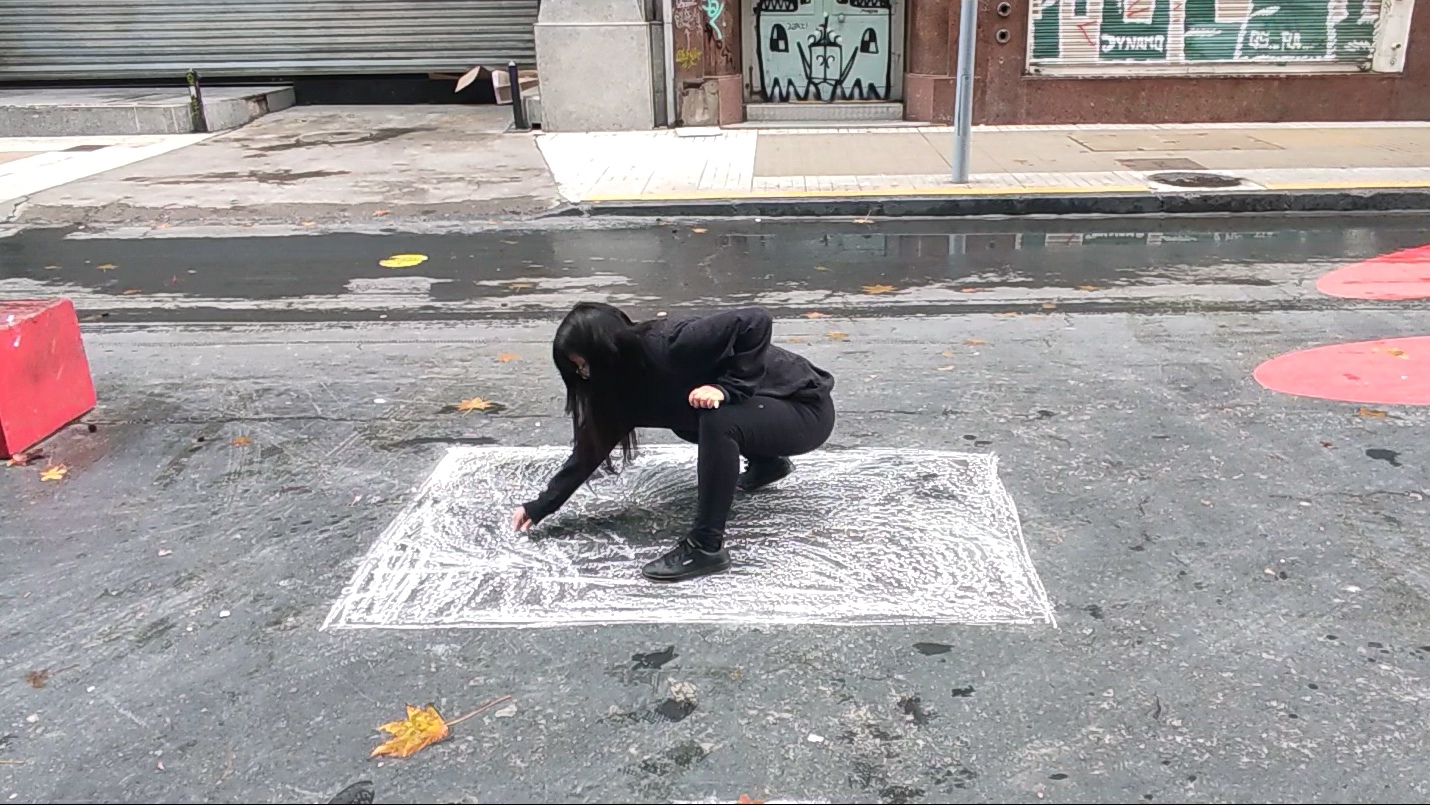
- Yssia Verano is a Peruvian visual artist, researcher, and performer based in Santiago, Chile. She is a PhD Candidate in Arts at the Pontificia Universidad Católica de Chile (PUC). She holds an MA in Gender Studies and a BA in Fine Arts with a major in Sculpture from the Pontificia Universidad Católica del Perú (PUCP). Her current doctoral research focuses on performance art as a tool to destabilize post-fascist strategies in the Peruvian context. Her work operates within the framework of Practice as Research (PaR), investigating the intersection of the body, political resistance, and state censorship. She focuses on the situated experience of the artist-researcher facing contemporary power structures in the Global South.
Earlier versions of this doctoral research (PUC) have been presented at internal seminars and international conferences specialized in Practice as Research (PaR) in Chile between 2025 and 2026. Each instance incorporated new academic discussions and peer feedback. This specific contribution expands on those findings by integrating a critical analysis of the escalating state censorship and the situated risk for artists within the current Peruvian context.
Requirements
The contribution will be delivered as a Poster Presentation using a Practice as Research (PaR) approach. Beyond the standard visual display, I plan to incorporate a tactile and multi-layered presentation format. This includes printed drawings and visual sketches designed to clarify the conceptual framework of my doctoral research. These visuals are not merely illustrative but serve as a primary record of the creative process and the 'situated experience' of the artist-researcher.
Additionally, I will include physical materials related to my artistic proposal. This hybrid format—combining traditional academic text with tactile and visual artifacts—aims to foster a direct, interdisciplinary dialogue with the audience.
Additionally, I will include physical materials related to my artistic proposal. This hybrid format—combining traditional academic text with tactile and visual artifacts—aims to foster a direct, interdisciplinary dialogue with the audience.
Vertical Surface: A standard poster board, corkboard, or wall space suitable for pinning/taping a main poster and several printed drawings and visual sketches.
Horizontal Surface: A small table, plinth, or shelf (approx. 50x50 cm) to place my personal device and physical materials and tactile objects.
No Electrical Requirements: No power outlets or AV equipment.
Horizontal Surface: A small table, plinth, or shelf (approx. 50x50 cm) to place my personal device and physical materials and tactile objects.
No Electrical Requirements: No power outlets or AV equipment.
My main concern is analyzing extremist "repertoires of fascism" without amplifying hate speech. Intervening in sensitive symbols (flag, flor de retama) is rooted in justice and reconciliation. Public "deactivations" use affective gestures requiring careful situational management. Finally, the "variegated scenario" acknowledges the researcher’s situated body facing political tensions while maintaining PaR integrity. All original works and authors are duly cited and credited.
No