Secondary tabs
Submission information
Submission Number: 236
Submission ID: 295
Submission UUID: 5d33ad91-c59b-4c43-b66a-7e3f27ac62b6
Submission URI: /form/submit-contribution
Created: Sat, 28 Feb 2026 - 15:04
Completed: Sat, 28 Feb 2026 - 16:15
Changed: Wed, 13 May 2026 - 08:14
Remote IP address: 83.175.181.205
Submitted by: Anonymous
Language: English
Is draft: No
Current page: webform_confirmation
Personal Information
Your contribution
Sinken: 113 Falls and the Obscured Conceptual World of Ausdruckstanz
English
This 120-minute movement workshop emerges from a practice-based PhD project investigating response as a choreographic strategy in relation to the movement practices of pioneers of modern dance in Poland and Germany. Through historical research, I encountered the semiotic foundations of Ausdruckstanz, rooted in the semantic density of the German language. In developing a choreographic response, I began an intensive studio practice that reconfigured my understanding of a forgotten kinetic language.
The workshop draws on Kirsten Seeligmüller’s research identifying 113 German verbs related to Sinken – such as Neigen, Versinken, Umkippen, and Abflauen. These verbs operate as ideophonic carriers of movement semantics: they activate subtle distinctions of movement qualities that exceed direct translation. Unfamiliar with the meaning of German kinetic verbs, my practice was informed by Johannes Birringer’s motion-based interpretation.
My gradual comprehension of this linguistic concept and the multiplicity of “falling” became emblematic of lineages in which the conceptual engine of Ausdruckstanz was gradually detached from its linguistic foundations and continued to circulate as a bodily form in contemporary dance, often without conscious awareness of its origins.
I invite participants to delve into the practices developed through my research thesis: first, to engage in kinesthetic resonance with the material and develop kinesthetic imagination as a research strategy; later, to progress towards a movement choir — an archival method used by pioneers of German modern dance — to experience descent as both a somatic event and a creative act. We will reflect on how Sinken examines embodied knowledge and juxtaposes processes of technogenetic homogenisation and aesthetic standardisation. The session positions artistic research not as representation of history but as its kinesthetic reactivation — offering a reparative practice that reclaims fragility as a creative force.
The workshop draws on Kirsten Seeligmüller’s research identifying 113 German verbs related to Sinken – such as Neigen, Versinken, Umkippen, and Abflauen. These verbs operate as ideophonic carriers of movement semantics: they activate subtle distinctions of movement qualities that exceed direct translation. Unfamiliar with the meaning of German kinetic verbs, my practice was informed by Johannes Birringer’s motion-based interpretation.
My gradual comprehension of this linguistic concept and the multiplicity of “falling” became emblematic of lineages in which the conceptual engine of Ausdruckstanz was gradually detached from its linguistic foundations and continued to circulate as a bodily form in contemporary dance, often without conscious awareness of its origins.
I invite participants to delve into the practices developed through my research thesis: first, to engage in kinesthetic resonance with the material and develop kinesthetic imagination as a research strategy; later, to progress towards a movement choir — an archival method used by pioneers of German modern dance — to experience descent as both a somatic event and a creative act. We will reflect on how Sinken examines embodied knowledge and juxtaposes processes of technogenetic homogenisation and aesthetic standardisation. The session positions artistic research not as representation of history but as its kinesthetic reactivation — offering a reparative practice that reclaims fragility as a creative force.
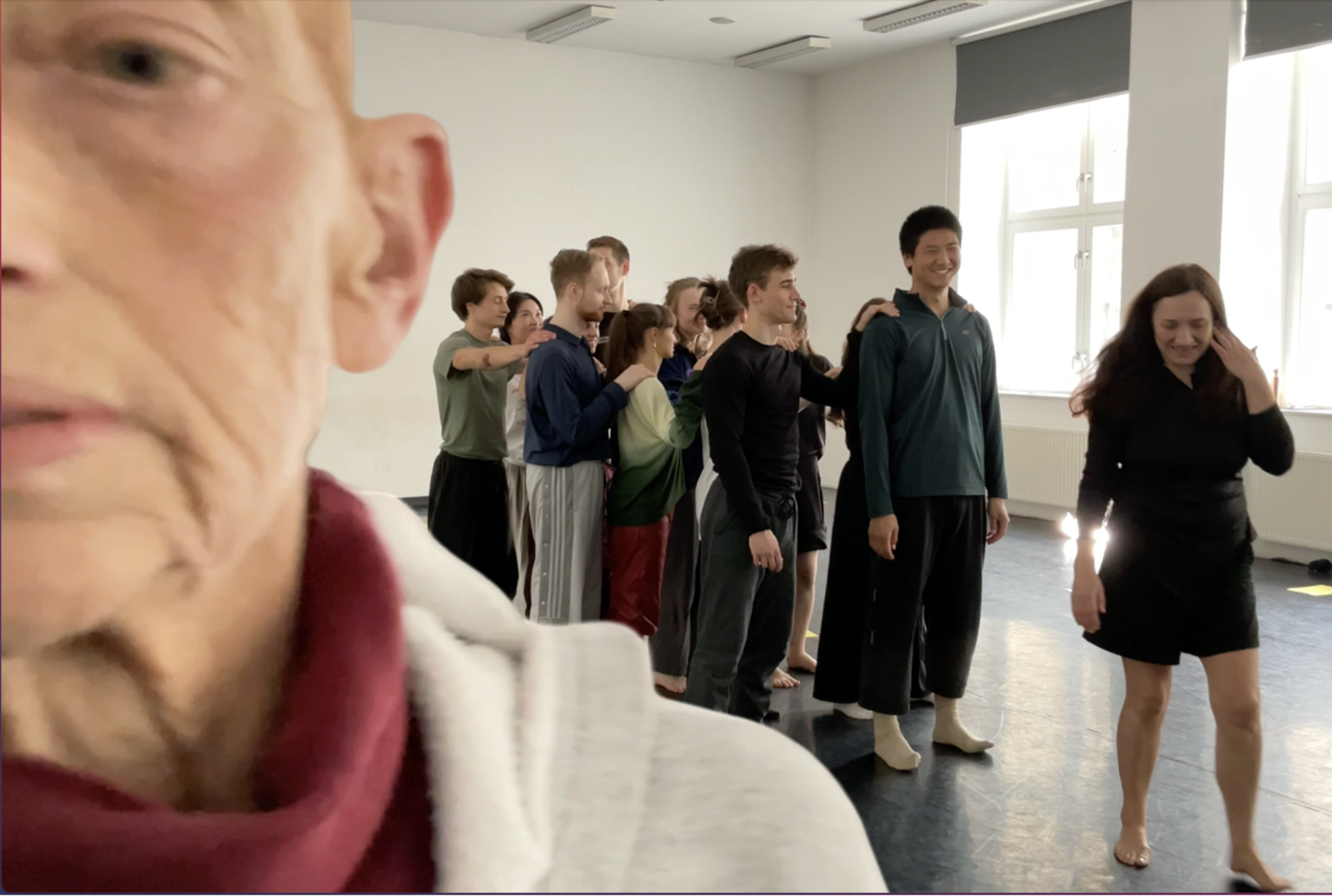
- Dancer, choreographer, and performer whose work combines movement memory, dance archives, and choreographic response. A graduate of the University of Warsaw, the Fryderyk Chopin University of Music, and Eurolab Berlin, she completed a three-year internship at Codarts Rotterdam. She holds a practice-based PhD from the University of Huddersfield (UK) for the thesis Choreographic Response to the Dance Biography of Nata Lerska. She is a visiting lecturer at the Dance Department of the Vocal and Acting Faculty at the Karol Szymanowski Academy of Music in Katowice. Her work has received recognition through several local and international scholarships.
2025
o "Response in Choreography". A course delivered to students at the Department of Dance at the Vocal and Acting Faculty of the Karol Szymanowski Academy of Music in Katowice, Poland. (Link to footage https://youtu.be/XTfANkBUdYQ).
o "Sinken: 97 Falls and the Research of Ausdruckstanz in Studio Practice". An online presentation at the Dance Studies Association Annual Conference "Indeterminate States: Bodies, Fields, Praxis", The George Washington University, USA.
o "Response in Choreography". A course delivered to students at the Department of Dance at the Vocal and Acting Faculty of the Karol Szymanowski Academy of Music in Katowice, Poland. (Link to footage https://youtu.be/XTfANkBUdYQ).
o "Sinken: 97 Falls and the Research of Ausdruckstanz in Studio Practice". An online presentation at the Dance Studies Association Annual Conference "Indeterminate States: Bodies, Fields, Praxis", The George Washington University, USA.
Requirements
The 120-minute workshop is based on a working archive of 113 pages derived from my research on German verbs related to descent. It unfolds in structured stages. Participants first engage in a thematic warm-up and what I call kinesthetic resonance with the material, identifying verbs and movement qualities that resonate with their bodily experience. They then develop an individual response, connecting this resonance to their own kinesthetic memory and composing three movements. In the second part, these movements are reduced into a two-dimensional exploration, followed by a guided kinesthetic imagination practice performed on the floor. The session culminates in the formation of a collective movement choir. Ideally, one or two percussionists or participants willing to contribute vocally would support the final stage.
A wooden (non-concrete) floor suitable for barefoot movement and floor work is required. Participants should be able to lie and move comfortably on the surface. Basic sound equipment is needed; I will play music directly from my iPhone and can provide the necessary adapter. For the second hour/40 minutes, it would be highly beneficial to have access to percussion instruments or volunteer percussionists to support the collective movement choir.
No specific legal, technical, or ethical risks are foreseeable at this stage. The workshop is based on voluntary participation and low-impact movement practices suitable for participants’ individual physical capacities
Yes
Iwona Wojnicka