Secondary tabs
Submission information
Submission Number: 216
Submission ID: 274
Submission UUID: edfd799f-a93f-405d-9485-5584558e7504
Submission URI: /form/submit-contribution
Created: Fri, 27 Feb 2026 - 13:59
Completed: Fri, 27 Feb 2026 - 14:06
Changed: Wed, 13 May 2026 - 08:50
Remote IP address: 92.208.74.159
Submitted by: Anonymous
Language: English
Is draft: No
Current page: webform_confirmation
Flagged: Yes
Personal Information
Your contribution
Epipoetic Un-Deception: AesthEtics of Reproduction and Kinship Rupture
English
This practice-based (PhD) project connects art-historical research on a UNESCO colour-reproduction project in painting with an auto-ethnographic archaeology of my own reproductive history. The latter is the focus of the presentation, which reflects on the relationship between original and reproduction in a biological-biographical exploration. After 33 years, the revelation that my presumed father is not biological—my actual father a bisexual friend and former lover of my parents—acts as an epistemic rupture that unsettles genealogical, bodily and narrative models of the self. My parents relied on what we would today call a queer relational constellation to overcome infertility and conceive a child, yet could or would not speak about it openly—silenced by muteness around reproduction and by a secrecy regime of a prudish GDR society.
The proposal explores how a family secret and its late disclosure produce endangered conceptual worlds of kinship, inheritance and identity, shaped by shame, secrecy and heteronormative expectations. The project asks how situated knowledges and minoritised life and love stories become speakable in artistic research and how autotheory and autoethnography can reframe such experiences as sources of insight rather than deficit. The German term „Ent‑täuschung“ (un‑deception) becomes a conceptual tool for thinking transformation and liberation together with loss and disorientation.
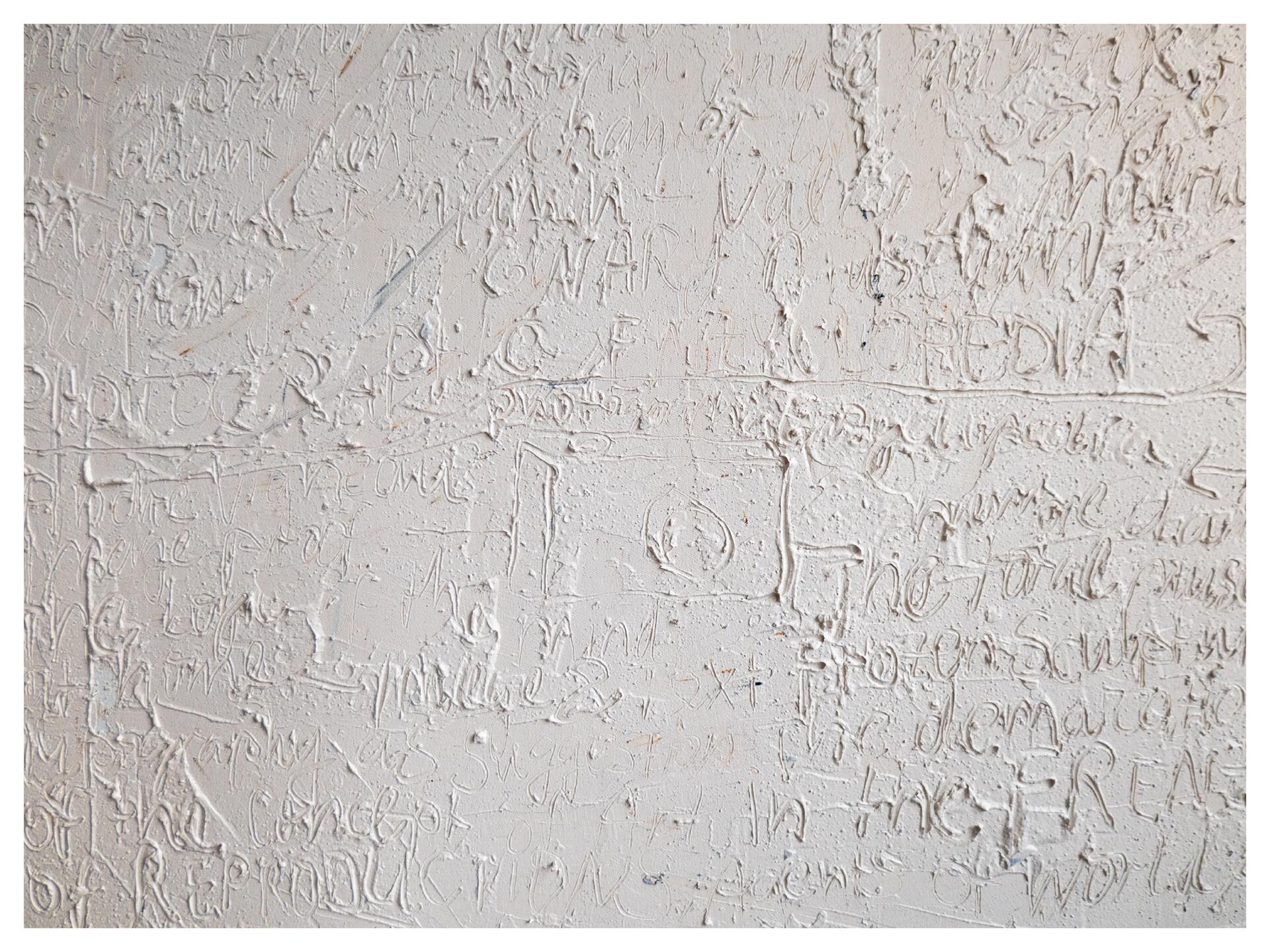
The presentation aligns with language-based artistic research and concept‑mapping practices. The poster operates as a poetic concept map at the threshold of image and text, (in)visibility and (un)readability, blending essayistic and poetic writing with diagrammatic, painterly and possibly wall-based marks. A brief live writing/mapping sequence will activate this material on site, inviting participants to share processes of making seeable and sayable what has (long) remained unsaid.
The proposal explores how a family secret and its late disclosure produce endangered conceptual worlds of kinship, inheritance and identity, shaped by shame, secrecy and heteronormative expectations. The project asks how situated knowledges and minoritised life and love stories become speakable in artistic research and how autotheory and autoethnography can reframe such experiences as sources of insight rather than deficit. The German term „Ent‑täuschung“ (un‑deception) becomes a conceptual tool for thinking transformation and liberation together with loss and disorientation.
The presentation aligns with language-based artistic research and concept‑mapping practices. The poster operates as a poetic concept map at the threshold of image and text, (in)visibility and (un)readability, blending essayistic and poetic writing with diagrammatic, painterly and possibly wall-based marks. A brief live writing/mapping sequence will activate this material on site, inviting participants to share processes of making seeable and sayable what has (long) remained unsaid.
- I am a visual artist and cultural and literary scholar working at the intersection of artistic research, art history and image politics. My practice-based PhD at Bauhaus University Weimar investigates UNESCO’s post-1946 colour-reproduction exhibitions and their aesthetic, ideological and geopolitical implications. In parallel, I explore questions of origin, kinship and subjectivation through language-based artistic research, painting, concept mapping and autotheory, focusing on what becomes seeable and sayable (or not) between text, image and space in collaborative and transdisciplinary settings.
Presentations of individual parts of the research were given as part of the Collaborative Research Centre “Transformations of the Popular” (University of Siegen, Germany) and as part of the structured doctoral programme “Art and Design Research” at the Bauhaus University Weimar. In this form and with its current focus, the proposed presentation will be shown for the first time at the SAR Conference 2026.
Requirements
During the poster presentations, I would like to activate the poster further by adding slight live writing, drawing and gestural markings to transform the experience. This fosters audience interaction: together, we reflect on the performativity of image-text constellations, exchange thoughts on 'making visible and audible', and expand the map performatively. Through dialogue, we translate the personal dramas and circumstances described into broader contexts.
A wall or stand would be needed to hang the poster. I can bring equipment for hanging it up if necessary. It would be ideal if there were some opportunities for movement and interaction with the audience in the room. If possible and technically feasible, the poster could also be activated and developed into a mural (using graphite/pencil or similar). In general, I like to respond flexibly to the given possibilities in a site-specific manner.
As the topic touches on sensitive and highly personal issues relating to birth, sexuality, relationships, family dynamics and power, I would issue a trigger warning if necessary. While there will be no highly sensitive or explicit elements in the presentation/performance, I would like to request that it be handled with sensitivity.
No