Secondary tabs
Submission information
Submission Number: 198
Submission ID: 253
Submission UUID: 38c6a62d-d5f0-427f-a19c-400c88bf6753
Submission URI: /form/submit-contribution
Created: Fri, 27 Feb 2026 - 00:02
Completed: Fri, 27 Feb 2026 - 00:42
Changed: Wed, 13 May 2026 - 08:47
Remote IP address: 98.38.1.161
Submitted by: El Brush
Language: English
Is draft: No
Current page: webform_confirmation
Flagged: Yes
Personal Information
Your contribution
Fearfully and wonderfully made: Using body maps to explore embodied religious trauma in autoimmunity
English
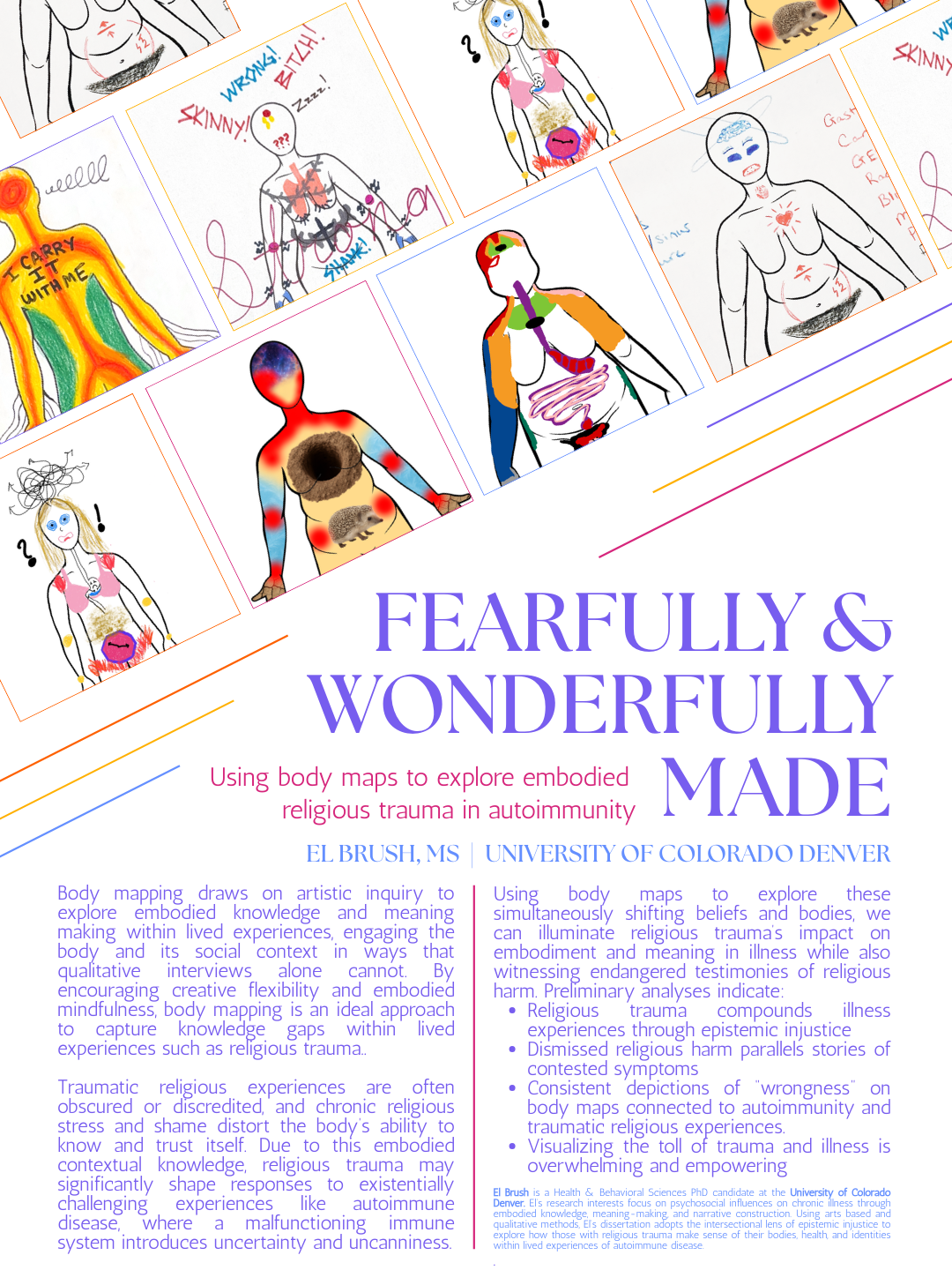
Body mapping draws on artistic inquiry to explore embodied knowledge and meaning making within lived experiences, engaging the body and its social context in ways that qualitative interviews alone cannot. In body maps, story-tellers visually represent their experiences with unique colors, symbols, and words drawn on a body outline, and co-constructed interpretive keys support data analysis. By encouraging creative flexibility and embodied mindfulness, body mapping is an ideal approach to capture knowledge gaps within lived experiences such as religious trauma.
Traumatic religious experiences are often obscured or discredited, creating an epistemic vacuum around religious harm. Chronic religious stress and shame also embed themselves within the flesh, distorting the body’s ability to know and trust itself. Due to this embodied contextual knowledge, religious trauma may significantly shape responses to existentially challenging experiences like autoimmune disease, where a malfunctioning immune system introduces uncertainty and uncanniness. Using body maps to explore these simultaneously shifting beliefs and bodies, we can illuminate religious trauma’s impact on embodiment and meaning in illness while also witnessing endangered testimonies of religious harm.
Beginning in January 2025, this ongoing research study includes eight story-tellers who created body maps following semi-structured interviews on religious and health histories. Preliminary analyses indicate religious trauma compounds illness experiences through epistemic injustice. Dismissed religious harm parallels stories of contested symptoms, and body maps consistently depict “wrongness” connected to autoimmunity and traumatic religious experiences. Visualizing the toll of trauma and illness overwhelmed many story-tellers, but acknowledging their experienced reality with art also increased bodily connection and acceptance, indicating the value of body maps as a research method and an embodied exercise.
Traumatic religious experiences are often obscured or discredited, creating an epistemic vacuum around religious harm. Chronic religious stress and shame also embed themselves within the flesh, distorting the body’s ability to know and trust itself. Due to this embodied contextual knowledge, religious trauma may significantly shape responses to existentially challenging experiences like autoimmune disease, where a malfunctioning immune system introduces uncertainty and uncanniness. Using body maps to explore these simultaneously shifting beliefs and bodies, we can illuminate religious trauma’s impact on embodiment and meaning in illness while also witnessing endangered testimonies of religious harm.
Beginning in January 2025, this ongoing research study includes eight story-tellers who created body maps following semi-structured interviews on religious and health histories. Preliminary analyses indicate religious trauma compounds illness experiences through epistemic injustice. Dismissed religious harm parallels stories of contested symptoms, and body maps consistently depict “wrongness” connected to autoimmunity and traumatic religious experiences. Visualizing the toll of trauma and illness overwhelmed many story-tellers, but acknowledging their experienced reality with art also increased bodily connection and acceptance, indicating the value of body maps as a research method and an embodied exercise.
- El Brush is a PhD candidate at the University of Colorado Denver in Health and Behavioral Sciences. El’s research interests focus on biopsychosocial influences on chronic illness through embodied knowledge, meaning-making, and narrative construction. Using arts-based and qualitative methods, El’s dissertation adopts the intersectional lens of epistemic injustice to explore how those with religious trauma make sense of their bodies, health, and identities within lived experiences of autoimmune disease.
Previous presentations of this research were held at the Society for Applied Anthropology’s 2025 Annual Meeting for a panel titled Contested Illness: (Not) Suffering in Silence. This research was also presented at the 2025 American Anthropological Association Annual Meeting for a panel titled “Other” Worldly Methodologies: Queer and Crip Embodied Methods.
Requirements
In addition to the poster for my presentation, printed zines will be provided including participant body maps and quotes from their spoken testimonios. This zine will also include a blank body outline for interested individuals to create their own body maps. Providing physical materials in conjunction with the poster presentation will hopefully add to the tangibility and embodied nature of this artistic research.
Poster will be approximately 36x42 inches in landscape orientation, supplemented by printed zine containing particpant body maps and testimonio quotes.
To protect participant anonymity, this study uses pseudonyms for participants unless requested otherwise, and any names, locations, or identifying details are removed from interview transcripts. Participants can pause or stop interviews at any point, because speaking about trauma should be a choice where participants can exercise agency. As of December 2024, the Colorado Multiple Institutional Review Board approved this study (COMIRB #24-2126), with a following amendment approved in July 2025.
Yes
El Brush