Secondary tabs
Submission information
Submission Number: 190
Submission ID: 245
Submission UUID: d4b38a28-aa72-4efd-bbe2-f68c97197ba2
Submission URI: /form/submit-contribution
Created: Thu, 26 Feb 2026 - 17:40
Completed: Sat, 28 Feb 2026 - 21:00
Changed: Wed, 13 May 2026 - 08:54
Remote IP address: 158.47.221.225
Submitted by: Anonymous
Language: English
Is draft: No
Current page: webform_confirmation
Flagged: Yes
Personal Information
Your contribution
Embodied music
English
The notion of gestural notation refers to those semiographic systems that encode physical action as a primary musical parameter, foregrounding the performer’s embodied engagement with the instrument. This approach responded to the growing exploration of extended techniques and experimental art practices that exceeded the descriptive capacity of
traditional notation.
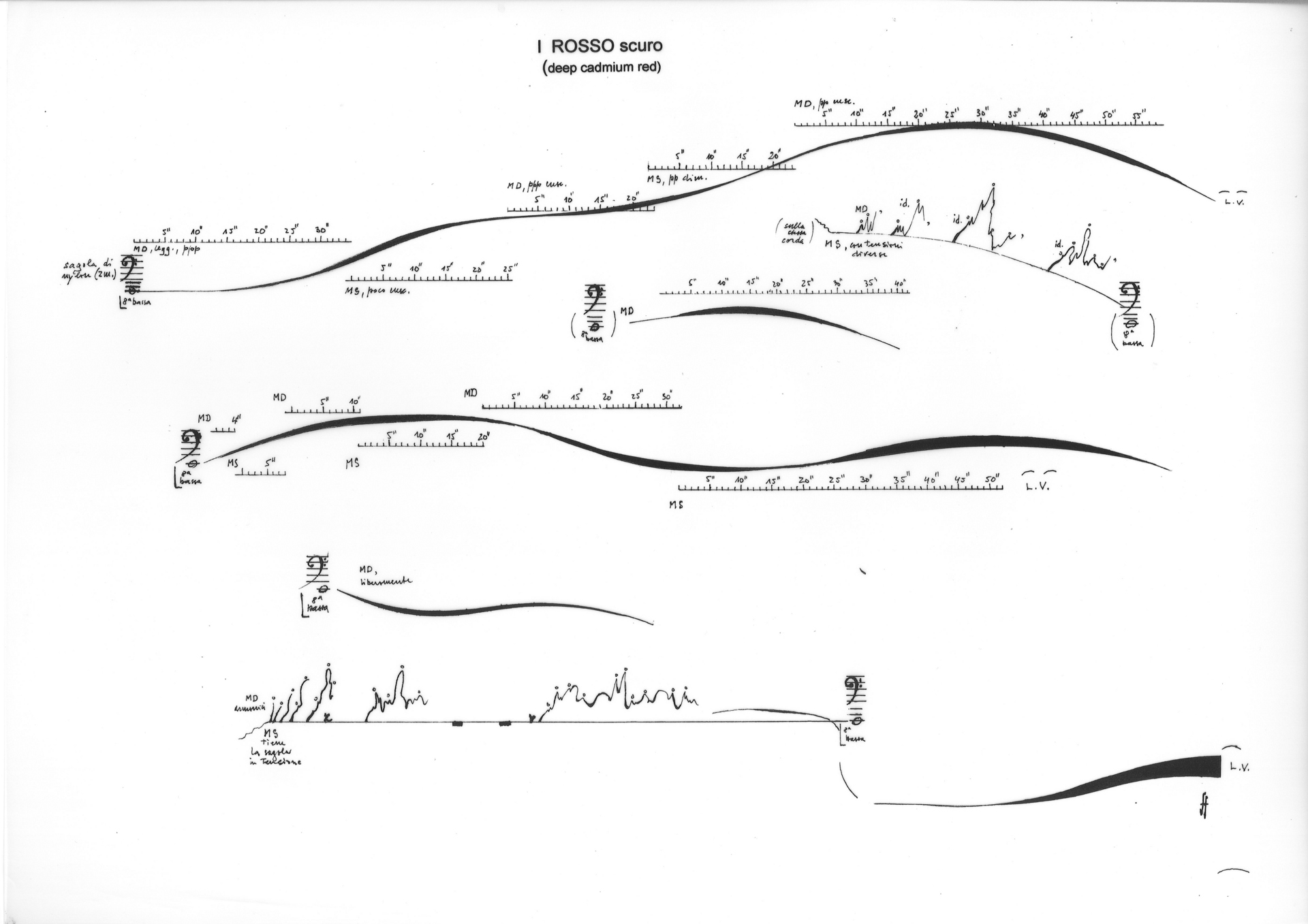
Mario Bertoncini’s artistic research originates in the exploration of unconventional physical interactions with the piano, transforming the instrument into a resonant field of spatial actions. He expanded the concept of prepared piano as it was intended by John Cage: his preparations included nylon cords knotted between the lid and the strings, DC motors and many other self-made artifacts. In his works, gesture is not merely a means of sound production but becomes the primary carrier of a musical thought.
The graphic layout of Bertoncini’s scores reveals how embodied experimentation is translated into visual form. In works like Cifre or Suite “colori” the concept of composition itself is questioned: composing, in a post-serial point of view, doesn’t imply anymore a process of structurization of pre-determined materials but, rather, it means shaping an innovative gesture.
By examining the relationship between this experimental approach and Bertoncini’s usage of the magnetic tape as a type of fixed media, this paper wants to present my own ongoing research project as both a pianist and a composer on “piano-transduced feedback”.
Moreover, this paper frames gestural notation as an example of an experimental artistic practice that foregrounds minoritized and potentially endangered forms of knowledge transmission.
In an era of increasing digital uniformity, his work asserts the centrality of corporeality and material interaction. Gesture emerges as both a symbolic and practical device: a trace of research, a tool of resistance, and a medium through which musical knowledge is enacted, preserved,
traditional notation.
Mario Bertoncini’s artistic research originates in the exploration of unconventional physical interactions with the piano, transforming the instrument into a resonant field of spatial actions. He expanded the concept of prepared piano as it was intended by John Cage: his preparations included nylon cords knotted between the lid and the strings, DC motors and many other self-made artifacts. In his works, gesture is not merely a means of sound production but becomes the primary carrier of a musical thought.
The graphic layout of Bertoncini’s scores reveals how embodied experimentation is translated into visual form. In works like Cifre or Suite “colori” the concept of composition itself is questioned: composing, in a post-serial point of view, doesn’t imply anymore a process of structurization of pre-determined materials but, rather, it means shaping an innovative gesture.
By examining the relationship between this experimental approach and Bertoncini’s usage of the magnetic tape as a type of fixed media, this paper wants to present my own ongoing research project as both a pianist and a composer on “piano-transduced feedback”.
Moreover, this paper frames gestural notation as an example of an experimental artistic practice that foregrounds minoritized and potentially endangered forms of knowledge transmission.
In an era of increasing digital uniformity, his work asserts the centrality of corporeality and material interaction. Gesture emerges as both a symbolic and practical device: a trace of research, a tool of resistance, and a medium through which musical knowledge is enacted, preserved,
- Jacopo Petrucci is a PhD researcher at Conservatorio “A. Casella” dell’Aquila with a project named “Estetica del Limite” which focuses on the process of expansion of the structural limits of the piano instrument led by twentieth-century and contemporary experimental music.
The research combines source-based and performance-based methodologies with an analytical approach to technology-mediated compositions.
{Empty}
Requirements
Link RC: https://www.researchcatalogue.net/shared/d9dd52f7e2eb4e37c42a96d29f9ccd05
The ideal setting for this performance requires the presence of a grand piano, which will be suitably prepared through the application of a system of multiple acoustic transducers provided by the performer. The installation of the devices is entirely non-invasive and does not compromise the instrument’s structural or acoustic integrity.
In the absence of a piano, the performance may be realised using any large resonant surface of comparable dimensions, preferably made of solid wood. The acoustic outcome of the transduced-feedback system is inherently responsive to the characteristics of the performance space.
In the piano version, the performance alternates between sections for piano and live electronics and sections dedicated exclusively to transduced feedback, with a total duration of approximately 30 minutes. In the alternative versionthe duration is reduced to approximately 15 minutes.
The ideal setting for this performance requires the presence of a grand piano, which will be suitably prepared through the application of a system of multiple acoustic transducers provided by the performer. The installation of the devices is entirely non-invasive and does not compromise the instrument’s structural or acoustic integrity.
In the absence of a piano, the performance may be realised using any large resonant surface of comparable dimensions, preferably made of solid wood. The acoustic outcome of the transduced-feedback system is inherently responsive to the characteristics of the performance space.
In the piano version, the performance alternates between sections for piano and live electronics and sections dedicated exclusively to transduced feedback, with a total duration of approximately 30 minutes. In the alternative versionthe duration is reduced to approximately 15 minutes.
Spatial:
Any kind of performance space wider than 2m x 2m
Technical:
All electronic equipment is easily transportable and provided by the performer
Any kind of performance space wider than 2m x 2m
Technical:
All electronic equipment is easily transportable and provided by the performer
The installation of the devices is entirely non-invasive and does not compromise the instrument’s (ar any surface) structural or acoustic integrity.
The performance doesn't collide with any ethical concern.
The performance doesn't collide with any ethical concern.
Yes
{Empty}