Secondary tabs
Submission information
Submission Number: 359
Submission ID: 426
Submission UUID: 0a290b05-4d5e-40e6-9bd9-9be8e04aae38
Submission URI: /form/submit-contribution
Created: Mon, 2 Mar 2026 - 01:38
Completed: Mon, 2 Mar 2026 - 02:05
Changed: Wed, 13 May 2026 - 08:12
Remote IP address: 172.56.3.149
Submitted by: Anonymous
Language: English
Is draft: No
Current page: webform_confirmation
Personal Information
Your contribution
Drawing Close: Relational Proximity Across Difference in Marginalized Women’s Worlds
English
This research explores relational painting as a mode of inquiry through which knowledge and trust emerge in encounters between artist and participants, rather than approaching portraiture as representation alone. Painting is understood as a reciprocal practice shaped through shared time, attentive presence, and a determination among all parties to continue the work.
As the painter looks, the sitter looks back. Both engage in a reciprocal process of encountering one another. We recognize ourselves in the other and the other in ourselves—a process of recognition and identification between artist and sitter (Schuster, 2019). The resulting portrait is neither solely the artist’s nor the subject’s but both, producing something new (Schuster, 2019). It becomes a relational space where participants actively shape how they are seen, creating images that reflect lived experience while foregrounding agency.
Working within the socially and economically complex environment of a brothel in Kolkata, painting sessions are embedded in the rhythms of daily life—conversations, domestic activities, social interactions, and the material surroundings that shape lives. Through sustained engagement, the practice explores how individuals navigate this environment and express agency through gesture, posture, and self-presentation.
The project draws on Sarah Pink’s formulation of sensory ethnography, particularly her emphasis on knowledge as embodied and situated. Painting unfolds through mutual attention, allowing insights to emerge through shared experience rather than detached analysis.
Central to the work is the recognition that creative processes in complex contexts require collective effort. Practical challenges, including navigating resources and power structures, are addressed by drawing on the knowledge of everyone involved. Through ongoing problem-solving, relationships deepen and trust develops through repeated interaction and a shared commitment to sustaining the work.
As the painter looks, the sitter looks back. Both engage in a reciprocal process of encountering one another. We recognize ourselves in the other and the other in ourselves—a process of recognition and identification between artist and sitter (Schuster, 2019). The resulting portrait is neither solely the artist’s nor the subject’s but both, producing something new (Schuster, 2019). It becomes a relational space where participants actively shape how they are seen, creating images that reflect lived experience while foregrounding agency.
Working within the socially and economically complex environment of a brothel in Kolkata, painting sessions are embedded in the rhythms of daily life—conversations, domestic activities, social interactions, and the material surroundings that shape lives. Through sustained engagement, the practice explores how individuals navigate this environment and express agency through gesture, posture, and self-presentation.
The project draws on Sarah Pink’s formulation of sensory ethnography, particularly her emphasis on knowledge as embodied and situated. Painting unfolds through mutual attention, allowing insights to emerge through shared experience rather than detached analysis.
Central to the work is the recognition that creative processes in complex contexts require collective effort. Practical challenges, including navigating resources and power structures, are addressed by drawing on the knowledge of everyone involved. Through ongoing problem-solving, relationships deepen and trust develops through repeated interaction and a shared commitment to sustaining the work.
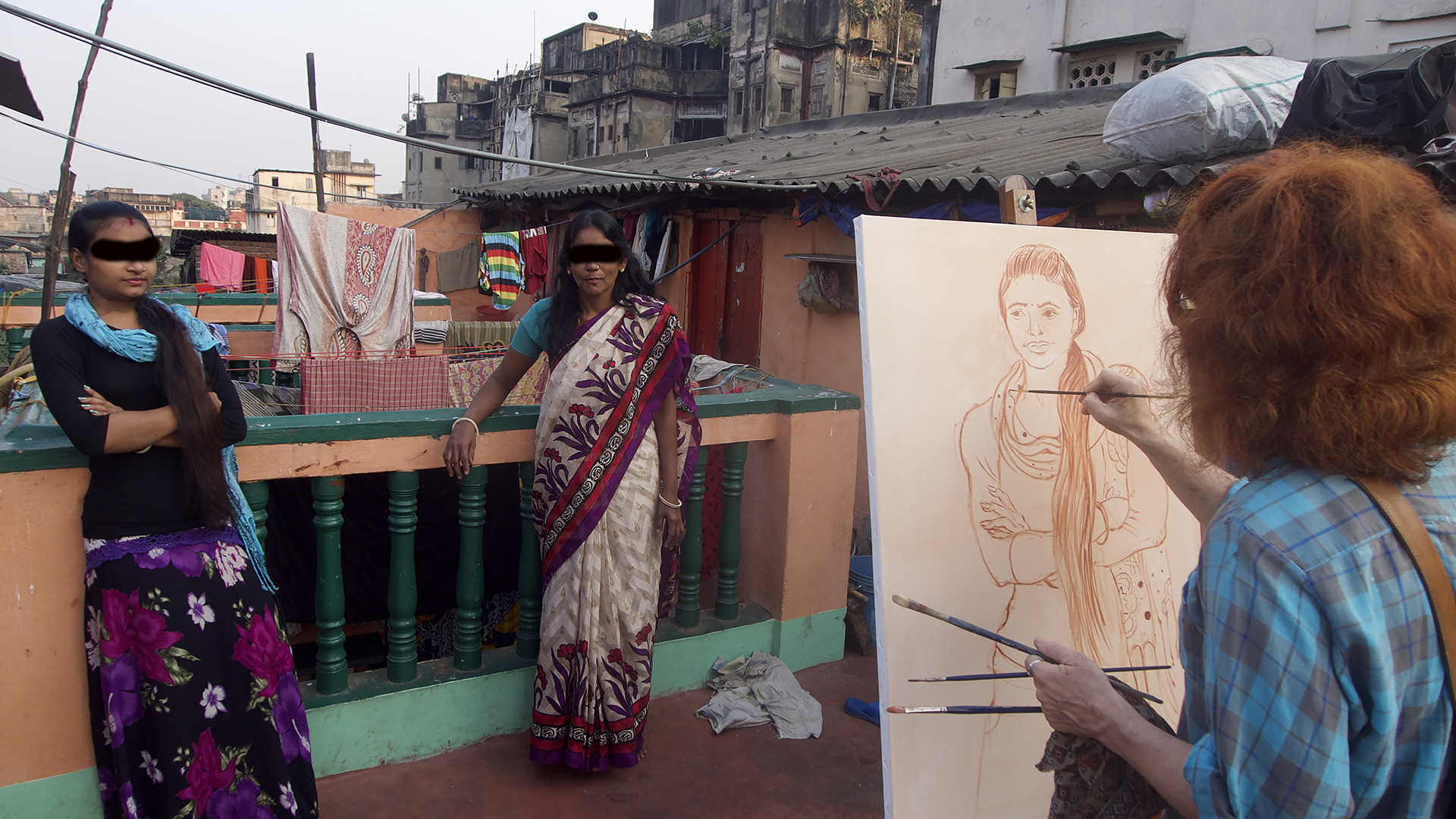
- Joan Kelly is an artist whose work is grounded in visual ethnography and trauma-informed practice. Her approach centers on community-participatory storytelling and artmaking, through long-term engagements with communities in crisis. She designs and facilitates drawing, portrait, and storytelling spaces creating supportive environments for reflection, expression, and relational connection in contexts shaped by social disruption, environmental crisis, and structural inequality. With over two decades of experience working with local partners, NGOs, educators, and community groups, Kelly uses art as a means of healing, sharing and recognition of lived experiences.
An earlier stage of this project was presented in 2022 at Rabindra Bharati University, Kolkata, in an invited talk titled Drawing as a Visual Research Methodology in Female Spaces, hosted by Prof. Swati Ghosh, Director of the Women’s Studies Center. The current contribution develops the work further by situating the painting practice within relational artistic research and sensory ethnography.
Requirements
The contribution will be presented as a 20-minute talk followed by 10 minutes for questions and discussion, including visual material from the portrait and drawing practice discussed in the paper.
Projector and screen for digital images, HDMI connection for laptop, and standard audio-visual setup for a slide presentation. Standard audience seating in rows is suitable.
The project involves portrait work developed through long-term relationships with participants in a sensitive social environment. Informed consent, ongoing dialogue, and participant agency in how they are represented are central to the process. Care is taken to avoid identifying details where appropriate and to ensure representations respect participants’ dignity, safety, and lived circumstances.
No