Secondary tabs
Submission information
Submission Number: 348
Submission ID: 414
Submission UUID: 628b6a3d-e59a-4c4d-be83-16dca246d457
Submission URI: /form/submit-contribution
Created: Sun, 1 Mar 2026 - 21:43
Completed: Sun, 1 Mar 2026 - 22:31
Changed: Wed, 13 May 2026 - 08:28
Remote IP address: 86.56.233.150
Submitted by: Anonymous
Language: English
Is draft: No
Current page: webform_confirmation
Flagged: Yes
Personal Information
Your contribution
Saluhan
English
Oralities are spoken languages existing outside the framework of reading and writing – living through embodied articulations of marginalized bodies. “Saluhan" looks at oralities as potentiality, rather than the written and material residue of language and their agency as they narrate a diffused and transitive space of ‘commoning’ to ask: what happens to the mother tongue in diaspora? Does the tenacity of language spoken in migrant communities attest to resilience or perhaps a recognition of language in its fullest sense: as a site of power, identity, longing, memory?
“Saluhan” is a participatory artistic research project working with the Filipinx community (first and second generation) in Helsinki to observe the use of their orality, and how this generates an identity that is both inside and outside the scope of assimilation or assumed Finnish-ness. Emphasized here are methodologies of resistance (silence, opacity or refusal) and transformation (hybridity, slang, linguistic innovations) as participants navigate multi-faceted identities. Through intergenerational and multilingual encounters, “Saluhan" brings forward situated forms of knowledge and lifeworlds which are invisible within the Nordic labor paradigm.
The project worked with eight Filipinx families and their stories are presented as a performance lecture by Jay Albaos and Stephanie Misa. As artist-researchers with Philippine migration backgrounds, we work multilingually and relationally, drawing on shared cultural references such as cooking and eating together, karaoke, dancing etc. These elements function as epistemic anchors—material and affective carriers of conceptual worlds shaped by feminized labor export, racialized care economies, and extractivist legacies. Through co‑creation, “Saluhan" becomes a site where these worlds can be held, tended to, and made seeable and sayable. Saluhan proposes artistic research as a collective practice of care, resistance, and knowledge‑making.
“Saluhan” is a participatory artistic research project working with the Filipinx community (first and second generation) in Helsinki to observe the use of their orality, and how this generates an identity that is both inside and outside the scope of assimilation or assumed Finnish-ness. Emphasized here are methodologies of resistance (silence, opacity or refusal) and transformation (hybridity, slang, linguistic innovations) as participants navigate multi-faceted identities. Through intergenerational and multilingual encounters, “Saluhan" brings forward situated forms of knowledge and lifeworlds which are invisible within the Nordic labor paradigm.
The project worked with eight Filipinx families and their stories are presented as a performance lecture by Jay Albaos and Stephanie Misa. As artist-researchers with Philippine migration backgrounds, we work multilingually and relationally, drawing on shared cultural references such as cooking and eating together, karaoke, dancing etc. These elements function as epistemic anchors—material and affective carriers of conceptual worlds shaped by feminized labor export, racialized care economies, and extractivist legacies. Through co‑creation, “Saluhan" becomes a site where these worlds can be held, tended to, and made seeable and sayable. Saluhan proposes artistic research as a collective practice of care, resistance, and knowledge‑making.
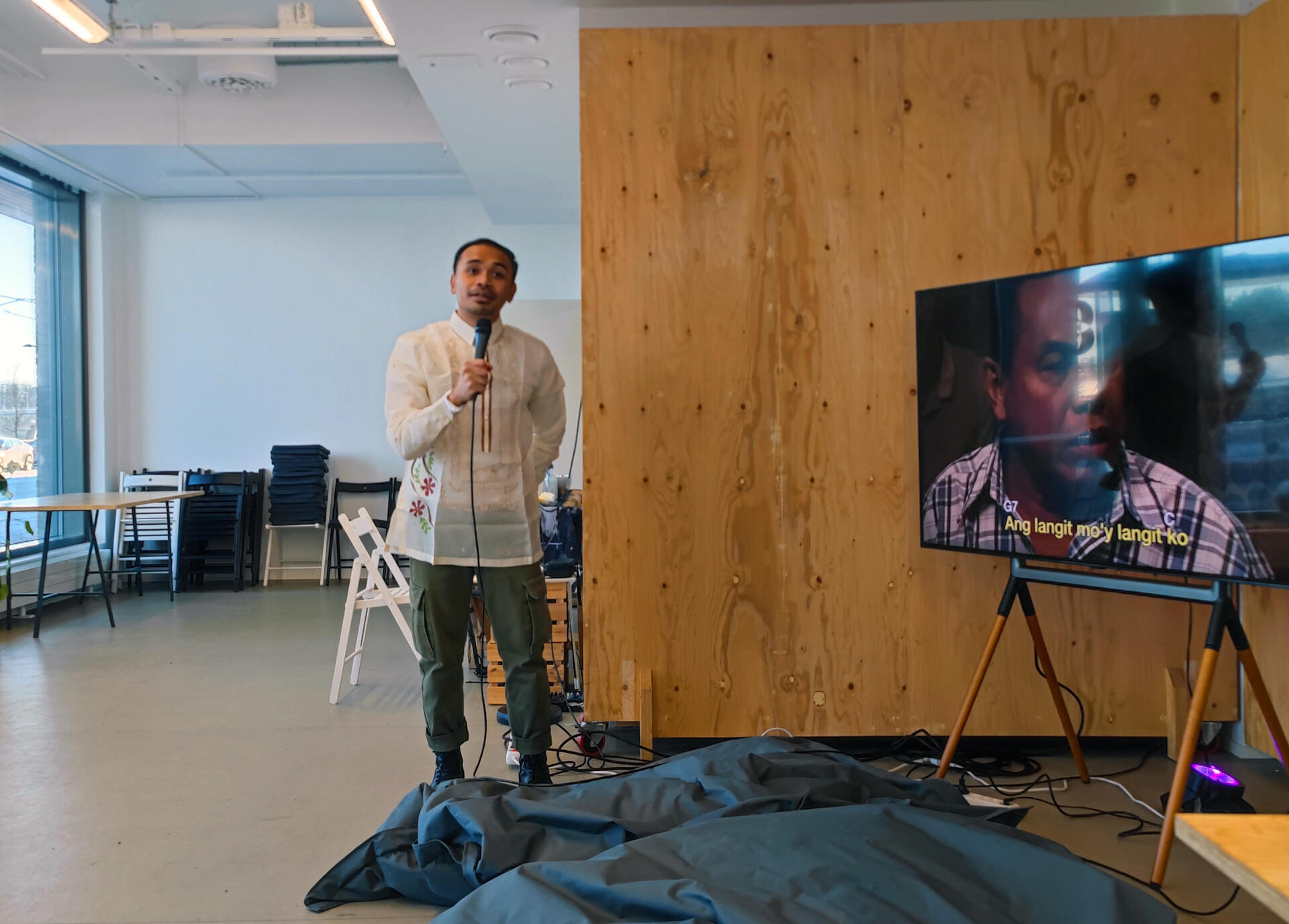
- Jay Albaos explores how migrants—workers, students of color, undocumented people—create place and selfhood in foreign environments. His method, artistic immersion, uses collaboration, participation, and dialogue to foster artistic creation and engage migration (policy) contexts. A former community worker with Indigenous Peoples and a theatre performer, he later studied Live Art in Helsinki and earned an advanced MA in Cultural Anthropology at KU Leuven. He is now a doctoral candidate at LUCA School of Arts/KU Leuven while working full-time at Decathlon. His work entwines anthropology, ethnography, and performance – moving between solo pieces and (community) collaborations. Born in Tacloban, Philippines he is based in Gent, Belgium.
- Stephanie Misa is a visual artist and researcher whose work centers on decolonizing methodologies. Her artistic practice connects multicultural collaboration, curating, and feminist criticism. In her work, Misa examines phenomena related to the orality and richness of multilingualism. She graduated from the Academy of Fine Arts Vienna and has a Master’s from the Interactive Telecommunications Program at NYU. She is currently a doctoral researcher at the University of Arts Helsinki.
Born in Cebu City, Philippines, Misa lives and works in Vienna, Austria and lectures at the Department of Artistic Strategies at the University of Applied Arts, where she leads an interdisciplinary research platform called the Island Tides Initiative.
{Empty}
Requirements
{Empty}
The performance lecture would require a projector or monitor, microphones ( for two performers) and speakers. A room for 40 persons (seated) should suffice.
None at this stage.
Yes
Stephanie Misa