Secondary tabs
Submission information
Submission Number: 343
Submission ID: 409
Submission UUID: 1ff4e41f-215d-4d88-9938-de6c99e27fbc
Submission URI: /form/submit-contribution
Created: Sun, 1 Mar 2026 - 19:05
Completed: Sun, 1 Mar 2026 - 20:39
Changed: Wed, 13 May 2026 - 08:39
Remote IP address: 77.251.185.161
Submitted by: Anonymous
Language: English
Is draft: No
Current page: webform_confirmation
Flagged: Yes
Personal Information
Your contribution
"Never Again. Five Stars": Game Design as Artistic Research into Platform Capitalism, Unsayability, and the Ethics of Remediation
English
"Never Again. Five Stars" takes its name from a contradiction found in thousands of Tripadvisor reviews of the Dachau Concentration Camp Memorial Site. In these entries, moral gravity coexists with the language of consumer evaluation. The same interface invites users to award five stars to hotels and restaurants and to Holocaust memorials.
Conceived as artistic research, the project investigates how digital platforms structure the conditions under which Holocaust memory is expressed, circulated, and valued. The reviews function as testimony, complaint, recommendation, and data trace, shaped by rating systems, character limits, and commercial imperatives of visibility. The project asks how these infrastructural conditions contour affect, authority, and legitimacy, and what forms of speech fall outside their frame.
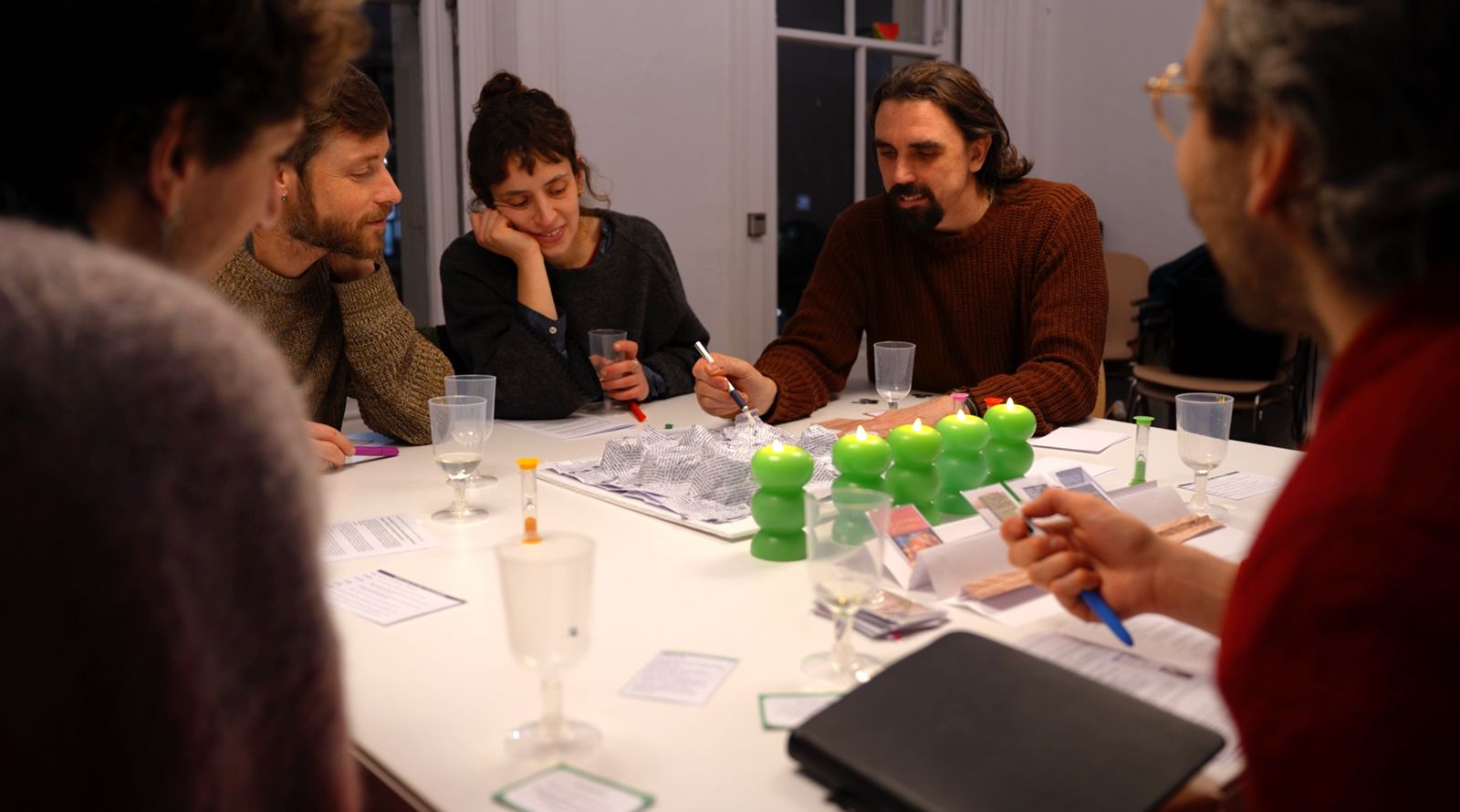
At the centre of the work is a board game developed from a curated archive of real anonymised reviews. Participants must decide how to act in relation to these texts: to preserve, delete, reform, or instrumentalise. Each action requires the review to be read aloud. Speech is not supplementary but constitutive, staging a shift from silent scrolling to embodied articulation and foregrounding voice, hesitation, and complicity.
Methodologically, the project treats the archive as a site of subjugated knowledge: vernacular, affective engagements with historical atrocity that are both solicited and disciplined by platform logics. The game's rule-based structure mirrors the administrative rationalities it interrogates, inviting players to experience their own implication in systems of ordering and extraction.
The presentation traces archival reading sessions, design iterations, and playtesting as moments in which ethical and formal tensions became operative rather than resolved, proposing gameplay as a mode of inquiry that mobilises discomfort as a critical resource while remaining accountable to the histories it engages.
Conceived as artistic research, the project investigates how digital platforms structure the conditions under which Holocaust memory is expressed, circulated, and valued. The reviews function as testimony, complaint, recommendation, and data trace, shaped by rating systems, character limits, and commercial imperatives of visibility. The project asks how these infrastructural conditions contour affect, authority, and legitimacy, and what forms of speech fall outside their frame.
At the centre of the work is a board game developed from a curated archive of real anonymised reviews. Participants must decide how to act in relation to these texts: to preserve, delete, reform, or instrumentalise. Each action requires the review to be read aloud. Speech is not supplementary but constitutive, staging a shift from silent scrolling to embodied articulation and foregrounding voice, hesitation, and complicity.
Methodologically, the project treats the archive as a site of subjugated knowledge: vernacular, affective engagements with historical atrocity that are both solicited and disciplined by platform logics. The game's rule-based structure mirrors the administrative rationalities it interrogates, inviting players to experience their own implication in systems of ordering and extraction.
The presentation traces archival reading sessions, design iterations, and playtesting as moments in which ethical and formal tensions became operative rather than resolved, proposing gameplay as a mode of inquiry that mobilises discomfort as a critical resource while remaining accountable to the histories it engages.
- Chris Groenveld is an artist, filmmaker, and practice-led researcher in the completion stage of their Art PhD at Goldsmiths, University of London. Their MA in Film (UCL) produced moving-image works examining community displacement and institutional critique. Their current research investigates how Holocaust memory is systematically processed on consumer review platforms, developing game-based methodologies that expose the extractive logic embedded in both digital platforms and academic analysis of historical trauma. The board game Never Again. Five Stars is the central artistic output of this doctoral work.
The board game at the centre of this presentation has been playtested in a small number of closed sessions, with staff at the UK's National Holocaust Museum and members of the Utrecht Games Lab, Netherlands, but has not previously been presented or published in an academic context. The research is ongoing and the current version of the game reflects findings from these sessions. The SAR 2026 Forum would be its first presentation to an international artistic research audience.
Requirements
The 20-minute presentation will combine a brief account of the iterative research process with a short live demonstration of key game mechanics and card content, allowing participants to directly encounter the research material. Slides will document the evolution of game design across multiple prototypes, foregrounding moments of impasse as productive sites of artistic inquiry rather than resolved findings. The presentation will specifically address how game mechanics came to function as both research method and critical argument. Ten minutes will be reserved for Q&A. The presenter is open to the possibility of a small group handling the physical game materials during discussion, if table space permits.
Standard projection setup (screen, HDMI connection) for slides. A table with space to display physical game components, board, cards, tokens, for demonstration and post-presentation handling. No specialist AV requirements.
Please note: the accompanying RC exposition is currently incomplete. I have been unable to successfully upload media due to difficulty using the RC interface with my accessibility software, and have not yet been able to schedule an access support appointment.
Please note: the accompanying RC exposition is currently incomplete. I have been unable to successfully upload media due to difficulty using the RC interface with my accessibility software, and have not yet been able to schedule an access support appointment.
The project uses anonymised Tripadvisor reviews of a Holocaust memorial as artistic material. Reviewers have not consented to this use. The research engages with these ethical tensions critically and reflexively, as they are constitutive of the inquiry rather than resolved procedurally. The presentation will involve reading some review content aloud, which may be distressing. Participants will be forewarned.
Yes
Chris Groenveld