Secondary tabs
Submission information
Submission Number: 274
Submission ID: 336
Submission UUID: c9ad577c-596e-42f2-9a97-68449ce0334e
Submission URI: /form/submit-contribution
Created: Sat, 28 Feb 2026 - 22:35
Completed: Sat, 28 Feb 2026 - 22:58
Changed: Wed, 13 May 2026 - 08:51
Remote IP address: 2.196.147.92
Submitted by: Anonymous
Language: English
Is draft: No
Current page: webform_confirmation
Flagged: Yes
Personal Information
Your contribution
Poetic Practice as Marginalised Language in a Neo-Conceptual Approach
English
During this roundtable, I aim to explore with my interlocutors several research processes and epistemological configurations that I have encountered in poetry over the years, both as a scholar and practitioner. I consider poetry an autonomous form of artistic practice and research, with its own methodologies, which are increasingly independent from both the traditional literary field and from domains in which it has often been subsumed within the art world, such as visual or concrete poetry and language-based conceptual art.
I would like to address four central questions:
1. How might the synthetic capacity of poetic language—together with its semantic density and stratification of meaning—inform contemporary artistic research and neo-conceptual practices?
2. In modern and contemporary contexts, poetry has often occupied a marginal position. It is frequently perceived as obscure and untranslatable, and its material manifestation as text appears more fragile than works produced in other media. In what ways might this marginality constitute a critical strength within today’s art world?
3. Poetry presents a productive paradox: although it is composed of words, its linguistic operations are so unconventional and intensified that it continually gestures toward the non-verbal. It deploys language in order to reach what exceeds language. What semantic and aesthetic bridges could this tension establish with other art forms?
4. I will also outline two theoretical trajectories I have been developing and that are related to the previous points: the “three obstacles” and the “knowledge without understanding.” The first proposes that poetry confronts and reconfigures cognitive, political, and emotional obstacles embedded in dominant systems of representation through its strategic misuses of language. The second suggests that, by engaging ontological and conceptual dimensions that resist comprehension, poetry generates an alternative approach to knowledge.
I would like to address four central questions:
1. How might the synthetic capacity of poetic language—together with its semantic density and stratification of meaning—inform contemporary artistic research and neo-conceptual practices?
2. In modern and contemporary contexts, poetry has often occupied a marginal position. It is frequently perceived as obscure and untranslatable, and its material manifestation as text appears more fragile than works produced in other media. In what ways might this marginality constitute a critical strength within today’s art world?
3. Poetry presents a productive paradox: although it is composed of words, its linguistic operations are so unconventional and intensified that it continually gestures toward the non-verbal. It deploys language in order to reach what exceeds language. What semantic and aesthetic bridges could this tension establish with other art forms?
4. I will also outline two theoretical trajectories I have been developing and that are related to the previous points: the “three obstacles” and the “knowledge without understanding.” The first proposes that poetry confronts and reconfigures cognitive, political, and emotional obstacles embedded in dominant systems of representation through its strategic misuses of language. The second suggests that, by engaging ontological and conceptual dimensions that resist comprehension, poetry generates an alternative approach to knowledge.
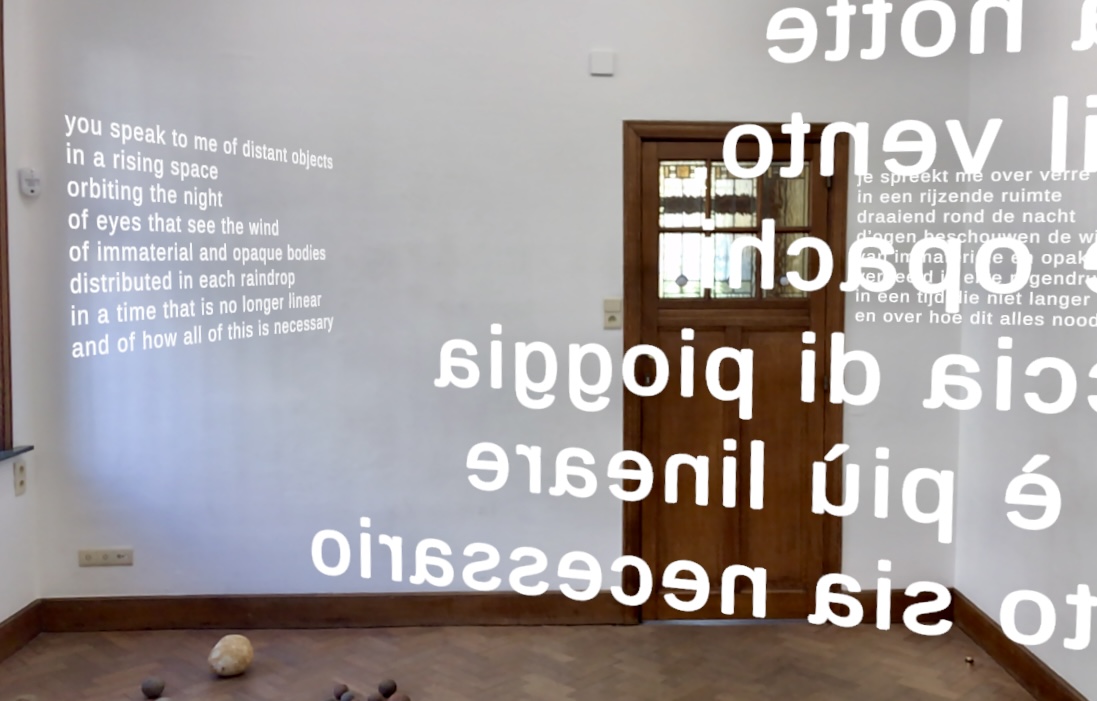
- Alessandro De Francesco (Pisa, Italy, 1981) is a poet, artist, and essayist. His latest books include: "Unstable Orbits" (edition taberna kritika, 2025); "Looop" (with Marco Mazzi, Gli Ori, 2025); "Continuum 2. Writings-Scritti-Écrits" (punctum books, 2024); "And Agglomerations, of Trees or" (Mousse Publishing, 2022). Among his solo exhibitions: "Cosmologie portative" (Celador, Brussels, 2025); "Expanded Poetry, Agglomerated Poetry" (Dreiviertel, Bern, 2024); "Expanded Poetry #1" (Der Tank, Basel, 2021). He holds a PhD from the University of Paris-Sorbonne and currently teaches at the Albertina Academy of Fine Arts in Turin and the Bern Academy of Arts. Website: www.alessandrodefrancesco.net
The concept of the “three obstacles” was presented in a lecture series at the European Graduate School. The concept of “knowledge without understanding” was developed in a paper for a special issue on object-oriented ontology and poetry in the international journal "Semicerchio" (Florence). Some aspects of this research are informed by the “Italian Network of Artistic Research” project at the Albertina Academy of Fine Arts in Turin, for which I served as an advisor.
Requirements
{Empty}
A cosy room if possible, where an intense discussion can take place.
No particular risks.
Yes
Alessandro De Francesco