Secondary tabs
Submission information
Submission Number: 224
Submission ID: 282
Submission UUID: 3f210db6-94bb-4aca-b29d-14da3e73adb6
Submission URI: /form/submit-contribution
Created: Fri, 27 Feb 2026 - 16:17
Completed: Fri, 27 Feb 2026 - 16:51
Changed: Wed, 13 May 2026 - 08:14
Remote IP address: 185.34.123.240
Submitted by: Anonymous
Language: English
Is draft: No
Current page: webform_confirmation
Personal Information
Your contribution
Plastic Magnitudes: Transdisciplinary Art-Science as Collective Intelligence for Invisible Environmental Threats
English
How can artistic research produce genuinely new knowledge about environmental threats that are structurally invisible and scientifically complex? Plastic Magnitudes, a transdisciplinary art-science collaboration with the European Commission's Joint Research Centre, demonstrates how integrating socially engaged art (SEA) with transdisciplinary research (TDR) addresses plastic particulates (micro-/nanoplastics) — threats that elude human perception and public engagement.
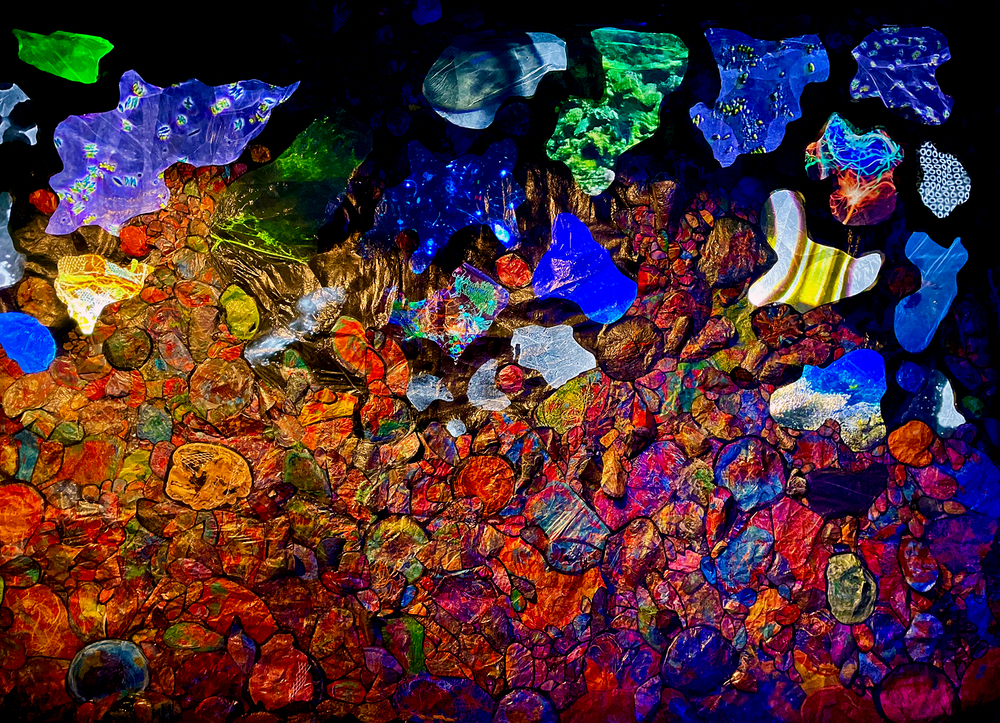
Plastic Magnitudes integrates TDR (co-design, co-production, co-implementation) with SEA (community engagement, facilitated dialogue, art-making) across three activities: beach clean-ups, community sculpture workshops using collected marine debris, and an immersive projection-mapped installation merging community-made forms with JRC scientific documentation. Each provides material tangibility, emotional immediacy, and visible local solutions for plastic particulats, advancing participants through a five-stage framework: awareness, emotional connection, perceived agency, visible efficacy, and sustained action.
Their integration generates material-affective accessibility: the conditions under which invisible threats become personally actionable. The work demonstrates that artistic research's unique capacity lies in producing knowledge that is simultaneously epistemically rigorous, emotionally resonant, and politically generative.
By creating conditions where policy-driven research is experienced rather than read, the work transformed affect across three constituencies: scientists processing paralysis, citizens moving from isolation to agency, and policymakers unmoved by reports until aesthetic encounter made contamination felt. Plastic Magnitudes demonstrates that artistic research can function as preventive political infrastructure, generating the collective capacity for action that governance requires but information transfer alone cannot produce.
Plastic Magnitudes integrates TDR (co-design, co-production, co-implementation) with SEA (community engagement, facilitated dialogue, art-making) across three activities: beach clean-ups, community sculpture workshops using collected marine debris, and an immersive projection-mapped installation merging community-made forms with JRC scientific documentation. Each provides material tangibility, emotional immediacy, and visible local solutions for plastic particulats, advancing participants through a five-stage framework: awareness, emotional connection, perceived agency, visible efficacy, and sustained action.
Their integration generates material-affective accessibility: the conditions under which invisible threats become personally actionable. The work demonstrates that artistic research's unique capacity lies in producing knowledge that is simultaneously epistemically rigorous, emotionally resonant, and politically generative.
By creating conditions where policy-driven research is experienced rather than read, the work transformed affect across three constituencies: scientists processing paralysis, citizens moving from isolation to agency, and policymakers unmoved by reports until aesthetic encounter made contamination felt. Plastic Magnitudes demonstrates that artistic research can function as preventive political infrastructure, generating the collective capacity for action that governance requires but information transfer alone cannot produce.
- Jacquelyn (JD) Whitman is an Irish-based artist, educator, and ocean advocate whose transdisciplinary research addresses the plastic pollution crisis at the intersection of marine science, policy, and creative practice. Her work employs eco-social art methodologies to translate complex scientific research into immersive, accessible experiences that raise awareness, empower communities, and foster sustainable action. Focusing on micro- and nanoplastics, ocean literacy, and eco-emotional resilience, she is a currently a PhD candidate at the University of Galway/Burren College of Art, an Artist-in-Residence at Atlantic Technological University, and an active alumna of the JRC’s SciArt Project, University of Iowa, and University of Chicago.
The development of Plastic Magnitudes was first co-presented in a Presentation of Residency at the Joint Research Center in Ispra, Italy.
Plastic Magnitudes was first exhibited in NaturArchy: Towards A Natural Contract, JRC SciArt Project’s Resonance IV Group Exhibition at iMAL - Center for Digital Cultures and Technology, Brussels, May-Sept 2024. It was subsequently re-installed at EU Green Week 2025 (Brussels), EU Maritime Day 2025 (Cork), EU Ocean Days 2025 (Brussels).
Plastic Magnitudes was first exhibited in NaturArchy: Towards A Natural Contract, JRC SciArt Project’s Resonance IV Group Exhibition at iMAL - Center for Digital Cultures and Technology, Brussels, May-Sept 2024. It was subsequently re-installed at EU Green Week 2025 (Brussels), EU Maritime Day 2025 (Cork), EU Ocean Days 2025 (Brussels).
Requirements
{Empty}
{Empty}
There are no risks or ethical concerns that are foreseeable at this stage.
No